


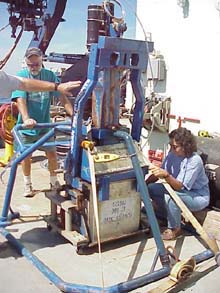
Science team members prepare the box core for an evening launch. Click on image for larger view.
Playing in the Mud!
September 18, 2001
Tanya Podchaski, Teacher
Bernards High, Bernardsville, New Jersey
"To me there is something completely and satisfyingly restful in that stretch of sea and sand and sky -- complete peace and complete fulfillment."
-- Anne Morrow Lindbergh
The night was quiet as most of the ship had gone to sleep, but Rose Petrecca, Hovey Clifford, George Hampson, and several crew members were on the stern of the ship sending down a 1/4-m-square box core into the deep blue sea. It would take about 45 min for it to descend 2,100 m to the ocean bottom. Once on the bottom, the shovel digs down, captures a 15-cm surface core sample, and begins its 45-min ascent.
Once the box core is back on board, the scientists take it apart. There are 24 subcores in the box, but they will seive, number, preserve, and box only the inner nine. Once the samples are stored, they are taken to the lab, sifted, and analyzed. Scientists then compare the data to previous data collected from the same site.
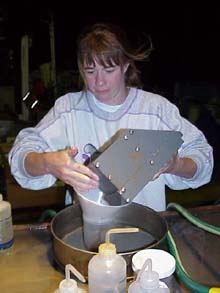
Log author Tanya Podchaski seives through a mud subcore. Click on image for larger view.
Rose Petrecca's group is contributing to nearly 20 yrs of ongoing research at the U.S. Minerals Management Service's (MMS) Mid-station 6 long-term study site. Between 1982 and 1983, MMS sent down six different box cores to get a baseline of the resident fauna. In 1983, they found close to 800 species in the mud. To everyone's surprise, this benthic habitat is as diverse as any rainforest.
I was intrigued when I heard about the mud's amazing diversity. The group would be doing three different box cores at the MMS site, so I decided to stick around and help. I had no idea what I was in for! Once the box core was up, everyone manned their stations. I was a seiver and preserver. When the subcores came out, Ms. Petrecca gave me the top 10 cm.
I took the sample to my seiving station and rinsed off the top 0-3 cm of mud into a specimen jar. I then took the remaining mud and poured it into a seive. I had to wash the mud with water and filter it before putting it into another jar. It was amazing how many critters inhabited this little scoop of mud! I saw foraminiferans (tiny, white-shelled invertebrates), crustaceans (baby crabs, lobsters, and shrimp), and polychaetes (marine worms). Many more creatures could not be seen with the naked eye, but the ones I did see were incredible. I had so much fun seiving the first box core that I stayed around and worked on the other two. Basically, I worked all night long in the mud, and by daybreak, I was a happy, muddy mess! I didn't turn in until 4 am Wednesday morning. I was tired, but I had witnessed one of the most diverse habitats on Earth.
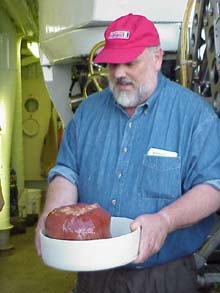
Chief Scientist Dr. Fred Grassle holds the "excellent specimen" that Alvin retrieved from the depths. Click on image for larger view.
While the mud business was going on, the deep submergence vehicle Alvin had gone out on a dive and returned. The biggest thrill of the dive was the "big animal" they had caught. Everyone, including chief scientist Dr. Fred Grassle, anxiously awaited Alvin's return to deck so they could see this find. When the sub was securely back in it's "garage," Dr. Grassle walked over to the specimen box and took a look inside. "Excellent specimen," he said. Then he filled a bucket with water to place the crature in, telling us that it was some sort of sea anenome.
Sign up for the Ocean Explorer E-mail Update List.


