
ocean explorer/Explorationshome/index
about site linkeducation linkprojects linkhistory linktechnology linkgallery linklibrary linkexploration linknavigation bar
explorations pageocean explorer home pagenoaa home page

exploration main page buttonDeep East buttonlogs

spacer
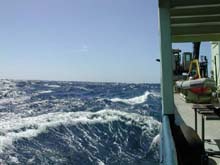
Wave action off the R/V Atlantis

Wave action off the R/V Atlantis. Click image for larger view.

Mitigating the Billows

September 12, 2001

Diana Payne
The Maritime Aquarium at Norwalk/
Connecticut Sea Grant

"Vessels large may venture more, but little boats should keep near shore." -- Benjamin Franklin, Poor Richard's Almanac

"The pilot cannot mitigate the billows or calm the winds." -- Plutarch, Of The Tranquility of the Mind

"Attention all hands, attention all hands. No one is allowed on the weather decks until further notice."
-- Gary Chiljean, Master, R/V Atlantis, Sept. 12, 2001
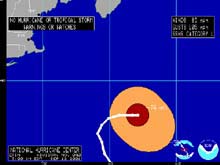
Hurricane Erin

The location of Hurricane Erin at 5 am EDT this morning was too close for comfort for the Deep East science team. Click image for larger view.

Through late Tuesday and early Wednesday, the R/V Atlantis headed east toward the next dive site, Bear Seamount. Swells from 15-18 ft and near 40-knot winds have made routine tasks, including sleeping, more difficult. Lying in my bunk below the main deck, I feel as though I am on a very strange amusement park ride. Movement is up and down, but also in a unique circular motion, like that of the demonstration of wave movement, showing a ball in a wave. There seems to be pressure pushing me down into my bunk. Water occasionally slams against the ship with a great boom, and there is a rhythmic, tin-like sound echoing through the hull.

The dive at Bear Seamount has been cancelled. We feel the effects of Hurricane Erin, now approximately 150 mi to the southeast. The storm has slowed somewhat, but it is hoped that a high-pressure system from the west will move her along on her eastward path. Erin began as a tropical disturbance and progressed to a tropical depression nearly a week prior to the start of the Deep East Expedition. The storm gained strength, then began to slow, and it seemed that our expedition would not be affected. Then, however, Erin increased in intensity again, and began to move northwest toward Bermuda. Forecasts placed the hurricane's path away from land and "safely out to sea."
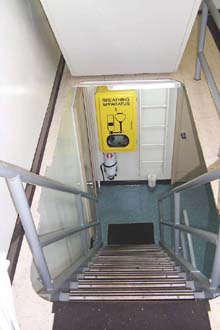
stairwell

Stairwells can be difficult to maneuver even in calm seas. Click image for larger view.

Hurricanes in the northern hemisphere occur primarily in late summer and early fall, with peak activity occurring during the month of September. A hurricane begins as a tropical disturbance, due in part to the large amount of moisture in the air and the large amount of latent heat rising from the surface of the ocean as evaporation. The resulting moist, unstable air rises to form clouds. As the central pressure falls and the winds begin to flow circularly around the low pressure, a tropical depression is formed. The eye begins to form, characterized by little or no clouds, warmer temperatures, and lighter winds. Sustained winds are less than 65 km/hr.

A tropical storm occurs when the central pressure drops and the wind speeds reach 65-120 km/hour. A hurricane is formed when sustained winds exceed 120km/hour. The hurricane is "fueled" as the sun heats the ocean water and evaporation occurs. This latent heat causes the air to rise quickly, and is the major driving force of a hurricane. The warm, moist air continues to "feed" the hurricane. As a hurricane moves over land or into colder waters, it begins to lose strength. Hurricanes do not form over the equator, as there is not enough force due to the rotation of the Earth (the Coriolis effect) to cause a storm to rotate. This planetary "spin" is necessary for the circular motion of a hurricane to form.

Work aboard the R/V Atlantis continues. The crew goes about their duties, watches change, meals are prepared and eaten, and scientists continue to review footage from Monday's dive. Coral specimens are analyzed. E-mail and news updates regarding events in New York City and Washington, DC are still the focal point of daily discussions. As we reach the midpoint of Leg 1 of Deep East, we are mindful of the events that have taken place ashore, and anxiously await our reunion with family and friends.

(top)


Master of the R/V Atlantis

Gary Chiljean, Master of the R/V Atlantis, stares down Hurricane Erin. Click image for larger view.

Interview with Captain Gary Chiljean
Master, R/V Atlantis, Woods Hole Oceanographic Institution

Ocean Explorer: How long have you been the captain of the R/V Atlantis?

Capt. Chiljean: Forever! I have been the captain of the research vessel since it was commissioned in 1997. The Woods Hole Oceanographic Institution's first Atlantis ship was the oceanic research vessel for which the Atlantis Space Shuttle was named. Most of the space shuttles are named after oceanic research vessels. When the Atlantis was decommissioned, I then became the captain of the Atlantis II for the National Science Foundation. When the Atlantis II was decommissioned, I was assigned my present position as captain of the R/V Atlantis. The most common question I am asked is, "Why didn't they call it the Atlantis III?" The reason is that Roman numerals are not used on Navy ships. A ballot was sent around WHOI to get suggestions for the name of the new vessel. The name R/V Atlantis was the one that was chosen.

Ocean Explorer Team: Did you have a naval background or did you obtain the rank of Captain through some other path?

Capt. Chiljean:
I attended the Maritime College at the State University at Fort Schuyler, Bronx, New York. While at Fort Schuyler, I majored in meteorology because I was interested in the weather. When you are a Maritime graduate, you receive a U.S. Coast Guard license as a third mate. I then started my career with a Naval Reserve Commission. Soon after, I worked on an oil tanker for Exxon before I continued on in my career.

Ocean Explorer Team: What other types of vessels have you commanded in your career?

Capt. Chiljean:
I have always commanded oceanographic vessels, and only for WHOI. I was captain of the R/V Knorr for a period of two months, the Atlantis II, and now the R/V Atlantis.

Ocean Explorer Team: How are your responsibilities as the captain of Atlantis different from commanding something like a freighter or a commercial fishing vessel?

Capt. Chiljean:
The captain is responsible, no matter where. You are responsible for the crew's safety, so it really is no different. You are actually responsible for everything. As the captain, I concentrate or focus on the purpose of the cruise or mission and do most of my communicating with the chief scientist. I strive to provide the scientists the best service I can deliver. The main responsibility on this ship is the work with the Alvin submersible. Other types of ships have a different focus.

Ocean Explorer Team: Hurricane Erin looks like it might pose some problems for the Deep East Expedition over the next few days. Atlantis is almost 300 ft long. How would she fare in a hurricane like Erin?

Capt. Chiljean:
I would not choose to find out! Large waves would hit the vessel, and you may lose a lot of equipment. But I would first hold position, check where the hurricane might be heading, and then move out and get out of harm's way. Basically, this is what we had to do this morning. We receive many types of weather reports on the bridge in the form of e-mails, NAVTEX, and from satellite maps, quite often throughout the day. As a result, we are quite aware of potential hazards before they get into the area. If we did get into a large storm, however, we would take a beating, but we would pull through.

Interview by Caren A.D. Menard of the Ocean Explorer Team.

(top)


E-mail Updates | User Survey | Report Error On This Page | Site Index | Contact Us
Revised June 22, 2006 by the Ocean Explorer Webmaster
National Oceanic and Atmospheric Administration | U.S. Department of Commerce
NOAA Logo Commerce Logo
http://oceanexplorer.noaa.gov/explorations/deepeast01/logs/sep12/sep12.html