Photo & Video Log
This page contains photos and videos regarding the
Exploring the Hidden World of the Maritime Maya, 2011 Exploration taking place between May 9 to May 27, 2011. Click on any image to view
a larger version and for additional information.

If a movie camera icon
is
present, a video can be viewed by clicking on the image. Multiple
video formats are available on the linked pages. If a Podcast icon
is
present, a video or audio file is available for download or you can subscribe to the RSS Podcast Feed. ![]()
If a slideshow icon
is
present, a visual log of exploration images can be viewed. You can scroll
through them one by one, or select the play button for an automatic slideshow.
(HR) = "High Resolution" images available.
October 5
Dr. Goodman discusses the coring project at Vista Alegre and the clues to the site's past that can be found when opening up a core.
September 22
A panoramic view of Vista Alegre’s East Harbor as Dr. Dominique Rissolo explores the harbor’s shallow waters.
Images
Mission Summary
Trish measures the salinity and pH of the water to gather another data point for the salinity map of the area surrounding Vista Alegre. (HR)
Mission Summary
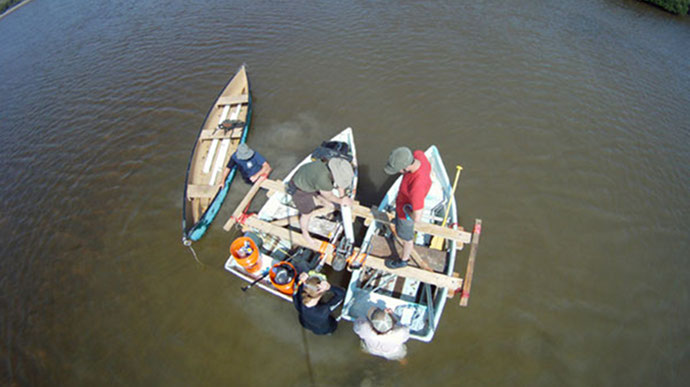
The team works together using a mobile coring platform and tripod to collect a core from the West Tidal Flat area. (HR)
Mission Summary
Collecting cores in the field required a team effort and coordination of equipment and people. (HR)
Mission Summary
One of the more interesting items uncovered was a nearly intact Ticul Thin Slate bowl. (HR)
Mission Summary
A cream-colored slate dish discovered during excavations -- most likely produced in areas near Chichen Itza. (HR)
Mission Summary
Jeffrey, Wes, Dominique and Beverly sit and discuss options for collecting cores in the East Harbor. (HR)
December 20 Log
The main municipal building in Kantunilkin displays festive and bright holiday lights. (HR)
December 20 Log
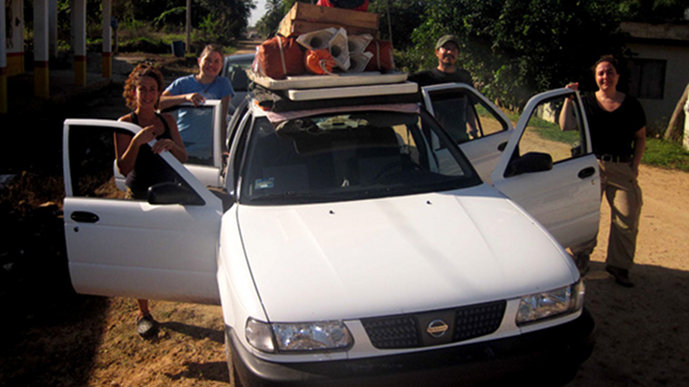
Trish Beddows and her team from Northwestern University packed and ready to roll out for the return trip to Vista Alegre. (HR)
December 20 Log
Here, Ed Mallon, chose a spot adjacent to one of the archaeo-logical structures at the site to string his hammock. (HR)
Georgia State University student, Hazel Sanchez, water-screens buckets of sediment from the excavation unit looking for artifacts. (HR)
Located on the surface in the eastern part of the site, this artifact represents the handle of a censer.
October 14 Log
The small fishing-village of Cabo Catoche is located at the northern-most tip of the Yucatan Peninsula. (HR)
October 14 Log
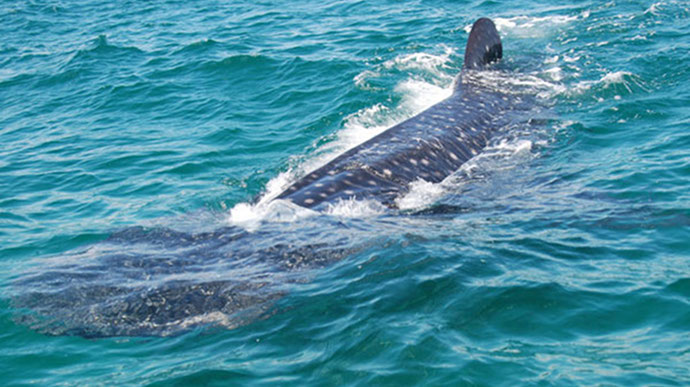
The whale shark (Rhincodon typus), or known in the Yucatan as el Tiburon Ballena is the largest living species of fish. (HR)
October 14 Log
A large portion of the northern Yucatan, including Isla Holbox is protected as part of the Yum-Balam Biosphere Reserve. (HR)
October 7 Log
Dr. Jeffrey Glover stands at the end of an interesting rock alignment discovered at the waters edge of the East Harbor. (HR)
October 7 Log
The electronic total station is set up at Vista Alegre to create a topographic map of the site. (HR)
October 7 Log
To fully survey the island, several transects had to be cut through the jungle using machetes. (HR)
October 7 Log
A bark beater, used by the ancient Maya to pound bark into paper, was discovered in one of the excavation units. (HR)
October 7 Log
A collection of shell beads, and animal bone fragments found in excavations at Vista Alegre. (HR)
October 5 Log
The team works together to carefully open up one of the core collected at Vista Alegre. (HR)
October 5 Log
Dr. Goodman samples a core in the field, while behind her Wes Patterson carefully photographs another core prior to sampling. (HR)
October 5 Log
A cross section of a core shows variations in the sediments captured in this particular core. (HR)
October 5 Log
Samples of the core are removed at 1-cm intervals using spoons, and packaged and labeled for further laboratory analysis. (HR)
October 3 Log
Working in a clean environment, Derek Smith extracts ancient DNA from archaeological mollusk samples. (HR)
October 3 Log
Seagrasses are abundant in the waters surrounding Vista Alegre and are a natural nursery for large, mobile gastropods. (HR)
October 3 Log
Derek Smith holds up one of the many mollusks found in and around middens at Vista Alegre. (HR)
September 26 Log
Derek Smith and Dominique Rissolo put the final touches on the coring platform. (HR)
September 26 Log
The Maritime Maya expedition team at Vista Alegre in front of the site’s main Palapa. (HR)
September 26 Log
Freddy Flores pays close attention as Trish explains the basic design and concept of creating a metal tripod to pull cores out of the mud. (HR)
September 26 Log
Trish Beddows, Jeffrey Glover and Dominique Rissolo use the pink tripod and portable coring platform. (HR)
September 26 Log
The latrine at Vista Alegre was significantly improved during the 2011 expedition. (HR)
September 25 Log
Conducting a preliminary survey of potential coring sites, Dan Leonard sinks a metal probe to estimate depth. (HR)
September 25 Log
Trish Beddows proudly stands with Freddy Flores, who created coring equipment, including this pink tripod for the project. (HR)
September 25 Log
Dominique and Beverly arrive at Vista Alegre on one of the local lanchas from Chiquila. (HR)
September 25 Log
Using PVC piping and a hammering device fabricated by Freddy Flores, the team sinks a core in the West Harbor. (HR)
September 22 Log
Dominique Rissolo ventures into the water to explore an interesting feature discovered not too far from the shoreline. (HR)
September 22 Log
Dominique Rissolo displays newly discovered pottery sherds from a midden located in the middle of the East Harbor. (HR)
September 19 Log
Dr. Patricia Beddows dips the hydrolab into waters near Vista Alegre, searching for any trace of freshwater. (HR)
September 19 Log
At the site’s main palapa, Beddows calibrates the hydrolab in preparation of surveying the water chemistry of the site. (HR)
September 16 Log
The entrance to Vista Alegre is lined with red mangroves, while an abundance of seagrass is visible through the clear waters. (HR)
September 16 Log
Dominique Rissolo heads out of a hardware store in Cancun, Mexico with a cart full of essential supplies for setting up the field camp. (HR)
September 14 Log
Dominique Rissolo heads out of a hardware store in Cancun, Mexico with a cart full of essential supplies for setting up the field camp. (HR)
September 14 Log
At the team’s base of operations in Kantunilkin, Dominique sorts, labels and prepares to pack gear before heading out to Vista Alegre. (HR)
September 14 Log
The truck is filled with gear, including two canoes, and ready to head off for Vista Alegre. (HR)
September 14 Log
Arriving at Vista Alegre at low tide, Dominique Rissolo tugs the overloaded lancha through the shallow waters of the lagoon. (HR)
September 14 Log
Once out of the lagoon, the lancha enters the mangrove-lined channel leading to the camp’s dock. (HR)
September 14 Log
Supplies for several weeks’ worth of archaeological, biological and geological investigation. (HR
History
A picture taken of the Castillo at Chichén Itzá. This is one of the most well-known buildings in Mesoamerica. (HR)
History
An obsidian blade fragment from the Pachuca source in the modern state of Hidalgo, Mexico. (HR)


View a slideshow of selected images representative for this specific exploration.