Photo & Video Log
This page contains photos and videos regarding the
Lophelia II 2010: Oil Seeps and Deep Reefs Exploration taking place this year from
October 14 – November 4, 2010. Click on any image to view
a larger version and for additional information.
If a movie camera icon
is
present, a video can be viewed by clicking on the image. Multiple
video formats are available on the linked pages. If a Podcast icon
is
present, a video or audio file is available for download or you can subscribe to the RSS Podcast Feed. ![]()
If a slideshow icon
is
present, a visual log of exploration images can be viewed. You can scroll
through them one by one, or select the play button for an automatic slideshow.
(HR) = "High Resolution" images available.
October 21 Log
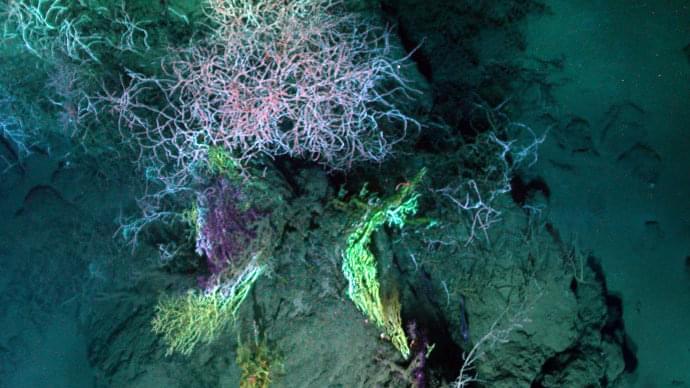
This rock outcropping is covered with gorgonian and scleractinian corals, and home to a galatheid crab.
October 20 Log
Video footage of a sixgill shark, a species of deep water shark fairly common in the Gulf of Mexico.
Images
November 3 Log
A single colony of coral with dying and dead sections, living tissue, and bare skeleton with very sickly looking brittle star.
November 2 Log
Ensign Bryan Begun is the Safety Officer aboard the Ronald H. Brown. Bryan easily mingled with the science team. (HR)
November 2 Log
Bruce Cowden, the Ronald H Brown’s bosun, is also an artist. Dr. Chuck Fisher asked him to capture the expedition in a watercolor. (HR)
October 31 Log
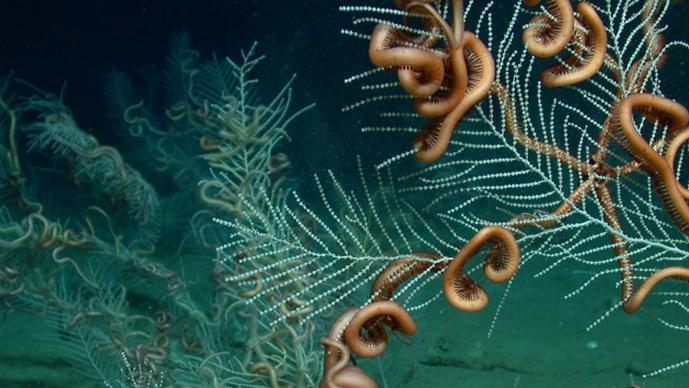
Close up of brittlestar Asteroschema sp. on the coral Callogorgia on the seafloor. (HR)
October 30 Log
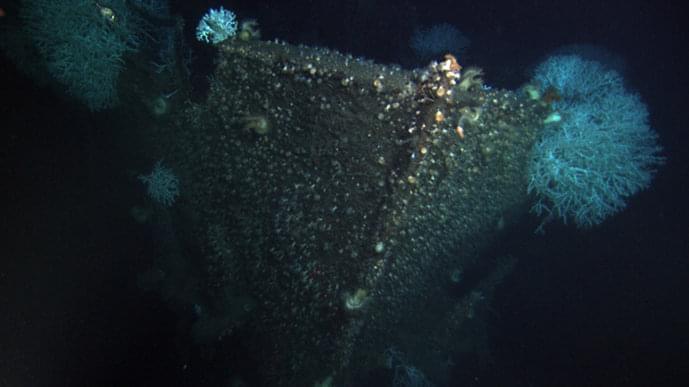
The graceful fantail of the ship is completely obscured by Lophelia communities. (HR)
October 30 Log
A section of hull covered in clusters of Lophelia and inhabited by Venus flytrap anemones and squat lobster. (HR)
October 29 Log
Rising over 10 meters off the seafloor, the bow and stowed anchors bear mute testimony to the 1942 catastrophe. (HR)
October 29 Log
Empty gun casings are scattered across the rear deck near the 4-inch gun mounted at the stern.
(HR)
October 29 Log
Although partially hidden by draping Lophelia, the letters G U L F O I are still visible across the transom. (HR)
October 27 Log
Large scale photo mosaics help scientists relocate sites that have been previously studied. (HR)
October 27 Log
Bathymetric maps guide scientists as they explore the seafloor for coral and reef sites. (HR)
October 27 Log
Photo mosaics are created using a series of photographs that overlap along a straight transect. (HR)
October 26 Log
The Jason ROV's robotic arm collects several stalks of black coral from the seafloor. (HR)
October 25 Log
Throughout the day scientists and grad students ready the samples for transport back to the labs on land. (HR)
October 24 Log
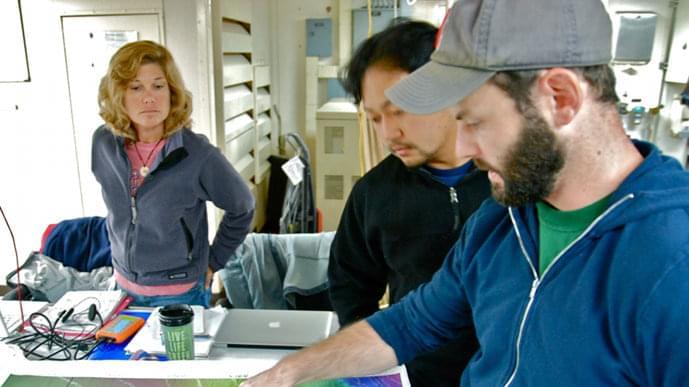
Knowing where the science sampling occurred is critical to future analysis. Lead Scientist, Erik Cordes, goes over each track plot. (HR)
October 23 Log
Live, bright white Lophelia coral is typically found amidst large amounts of dead coral. (HR)
October 21 Log
Microscopic view of the coral polyps of Paracalyptrophora sp. and Acanthogorgia sp.. (HR)
October 21 Log
Coral polyps of Paracalyptrophora sp. and Acanthogorgia sp.: differences in polyp morphology between species. (HR)
October 19 Log
The Spanish Dancer is a type of sea cucumber (Benthodytes) that is mesmerizing when it swims.
October 19 Log
These craters mark the formation of brine pools, from which salt has seeped through the seafloor.
October 18 Log
Close up image of a clump of mussels. Forming dense beds, deep-sea mussels are often early colonizers at cold seeps. (HR)
October 18 Log
Close up of a tubeworm “bush”, which mines for sulfide in the carbonate substrate with their roots. (HR)
October 18 Log
Seafloor photo mosaic, made up of more than a hundred images taken with the remote operated vehicle (ROV) Jason II. (HR)
October 17 Log
The sediment trap is hauled back to the surface after chronicling the flow of sediment and biological material for 10 months, 1,500 feet deep.
October 17 Log
Tim Shank handles one of the 21 'cups' deployed with a sediment trap to collect both organic and inorganic matter.
October 17 Log
A colony of lophelia provides shelter for galatheid crabs and a firm foothold for anemones.
Monitoring
A forward looking mosaic of the coral community at Marker F at 550 m depth, including colonies of Lophelia pertusa. (HR)
Monitoring
These Antipatharians in the genus Leiopathes range in color from white, through peach to orange and red. (HR)
Monitoring
Photo taken on May 27 near the Deepwater Horizon spill convergence zone, showing dark brown and red emulsion oil. (HR)
Archaeology
The tanker Gulfoil, prior to being sunk by a German U-boat in the Gulf of Mexico in 1942.
Biology
Two invertebrates commonly found associated with L. pertusa: the squat lobster Euminida picta (left) and the sea urchin Echinus sp. (right). (HR)
Mission Plan
Lophelia pertusa, Leiopathes glabberima, and an assortment of anemones on Roberts Reef. (HR)
Mission Plan
Down-looking mosaic of Lophelia covering the bow of the sister ship to the Gulfoil, the Gulf Penn. (HR)
Mission Plan
Ophiuroids on Lophelia pertusa, Callogorgia americana, and other gorgonians at Roberts Reef. (HR)
Introduction
An orange brisingid basket star on the large Lophelia pertusa reef at 450 m depth in Viosca Knoll 826. (HR)
Introduction
A down-looking mosaic of a coral community at 1400m depth, including a variety of hard and soft corals. (HR)