


Photo & Video Log
This page contains photos and videos taken during the expedition, "Investigating the Charleston Bump" that took place August 2 – 13, 2003. Click on any image to view a larger version and for additional information.
If a picture of a slideshow icon  is present, a visual log of exploration images can be viewed. You can scroll through them one by one, or select the play button for an automatic slideshow.
(HR) = "High Resolution" images available.
 Video & Slideshows
Summary
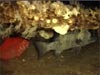
Wreckfish and red bream share space under a slab of manganese- phosphorite.
August 12
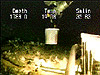
Manipulator arm retrieving carrion bucket.
August 12
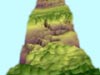
A 3-D flythrough was created from bathymetric data collected from the Charleston Bump. (mp4, 2.3 MB)
August 11
Slideshow of benthic invertebrates from the Charleston Bump. (mp4, 2.6 MB)
August 7
Video of a lionfish eluding capture. (mp4, 3.1 MB)
August 2
Bathynectes longspina crabs are frequently seen on the coral mounds. (mp4, 2 MB)
Images
Summary
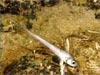
A grenadier or "rattail" hovers near the bottom.
Summary
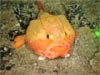
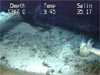
A gaper rests on its pectoral and pelvic fins at a depth of 1,860 ft.
Summary
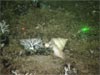
A "chimney" sponge and a fan-like sponge with associated sediment pile.
Summary
A "slit-shell" snail was collected by the JSL II at a depth of 1,870 ft.
August 16
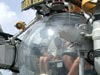
Rich Styles peers out of a porthole in the aft chamber of the JSL II submersible. (HR)
August 16
Dave Wyansk prepares for a dive to almost 1,800 ft in the JSL II sphere.
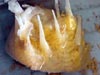
August 15
A "chimney" sponge may reveal new symbioses not previously witnessed. (HR)
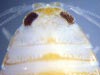
August 15
A parasitic crustacean. (HR)
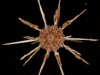
August 15
A pencil urchin with tubeworms attached to its spines. (HR)
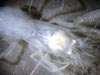
August 15
A tiny shrimp appears to mimic the translucent color of the glass sponge it inhabits.
August 14
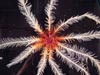
A colorful crinoid is just one of the interesting creatures collected.

August 14
Eating Judy’s amazing cooking.
August 14
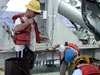
While working on deck, the science party and crew are required to wear hard hats and life vests. (HR)
August 14
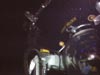
Deep below the photic zone in the JSL II submersible.

August 14
Steve Stancyk prepares the clod cards for deployment. (HR)
August 13
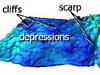
3-D visualization map of the Charleston Bump.
August 13
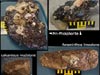
Various rocks collected during the Charleston Bump expedition.
August 13
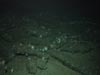
Large, table-sized slabs of rock.
August 13
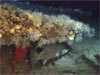
Red bream (Alphonsin) and wreckfish nestled under a rock ledge.
August 13
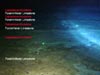
Vertical cliffs with alternating layers of carbonate rock.
August 13
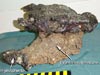
Manganese- phosphorite rock collected by the submersible at 1,827 ft depth.
August 12
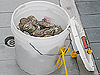
Carrion trap baited with rotting oyster. (HR)
August 12
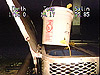
Manipulator arm retrieving carrion bucket.
August 12
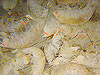
A mass of amphipods collected with the carrion trap. (HR)
August 12
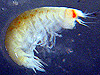
A close-up view of a tiny shrimp (amphipod).
August 12
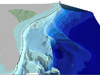
Ocean topography off the southeast portion of the United States.
August 12
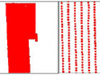
Data from the NOAA Ship Whiting.
August 12
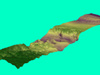
A topographic representation of the sea floor around the Charleston Bump.
August 12
Whiting bathymetry data helps determine target sites for upcoming dives. (HR)
August 12
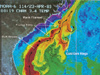
Sea surface temperature readings.
August 11
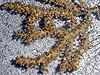
Soft coral provides a number of hiding places for benthic invertebrates.
August 11
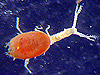
Cumaceans, also called lollipop shrimp.
August 11
Isopods of the order of Crustacea.
August 11
Jerry McLelland at the microscope.
August 10
Teacher-at-sea Connie Leverett after a 200-ft dive in the JSL II.
August 10
"Kids at sea" (aka the scientists) view the latest sample from 1,400 ft. (HR)
August 10
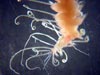
Scientists discovered this syllid attached to a rock. (HR)
August 9
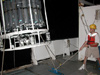
Just before midnight, Fred Andrus helps lower the 2,400- lb CTD over the ship’s starboard side. (HR)
August 9
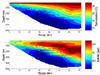
Temperature and salinity distributions from the edge of the continental shelf out to about the center of the Gulf Stream.
August 9
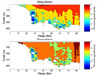
The current along a similar cross-stream transect as the temperature and salinity data.
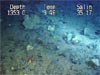
August 8
The sea bottom beneath the Gulf Stream is highly varied.
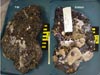
August 8
Sponges such as bryozoans and tunicates are absent from the exposed surface, yet dominate on the sheltered side. (HR)
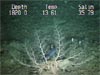
August 8
Passive filter feeders, such as this basket star, must find areas where strong currents sweep food through their arms.
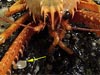
August 8
This little gooseneck barnacle only eats crab carapaces.
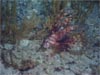
August 7
Scientists diving in the JSL II stumbled upon a red lionfish (Pterolis volitans).
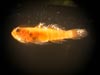
August 7
Scientists captured this unsuspecting goby, just 1.5 cm long. (HR)
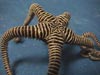
August 7
This species of brittlestar (Astroporpa annulata) is related to basket stars and lives clinging to soft corals.
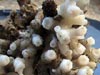
August 6
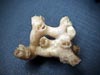
This specimen is the largest colonial coral collected to date.
August 6
A close-up of some of the individual polyps that comprise a colonial coral.
August 6
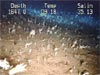
Abundant coral growth can be found in some areas with exposed hard bottom.
August 6
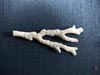
Tree-shaped coral are one of the most common types of coral seen on the exposed rock.
August 5
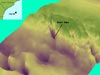
Scientists used multibeam bathymetric data to create a 3-D view of a portion of the Charleston Bump.
August 5
The Charleston Bump complex causes the Gulf Stream to speed up and be deflected offshore.
August 5
Biologist Dave Wyanski prepares to enter the JSL II sphere. (HR)
August 5
Sub crew member Jim Sullivan dives from the R/V Seward Johnson to the JSL II. (HR)
August 4
Chief Scientist Charlie Barans contemplates what to do next.
August 4
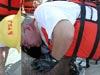
Jerry McLelland reaches into the pipe dredge.
August 4
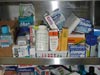
The ship maintains a plethora of medication for ills that befall scientists and crew at sea.
August 4
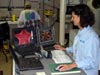
Project Oceanica Director Leslie Sautter pulls together expedition-related educational products.
August 3
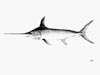
The Charleston Bump provides a valuable nursery habitat, and possibly spawning grounds, for swordfish.
August 3
The Johnson-Sea Link II submersible prepares to descend into the sea over the Charleston Bump.
August 3
The greeneye fish is one of many creatures observed during the first dive day.
August 2
The golden crab (Chaceon fenneri) with a black-bellied rose fish. (HR)
August 2
The deep-water galatheid Eumunida picta Longispina are commonly seen on the Lophelia mounds. (HR)
August 2
Nezumia forage along the edge of a basalt outcrop. (HR)


