


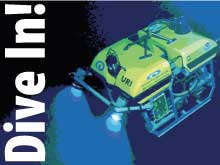
Lesson plans are available for this expedition. Download them from this page.
Galapagos Rift
Education
With the establishment of the Ocean Exploration Program within the National Oceanic and Atmospheric Administration (NOAA), there exists an unprecedented opportunity to focus millions of eyes on our essentially unexplored world of water---a world that may hold clues to the origins of life on Earth, novel energy sources, as yet undiscovered cures for human diseases, and previously unknown metabolic pathways. Specifically, the Galapagos Rift Expedition has great potential for generating exciting outreach and education opportunities as part of NOAA's Ocean Exploration Program education efforts.

The exploration of deep-sea hydrothermal vent communities provides a wonderful opportunity to educate about cutting edge technology, and the incredible and remote places it can take us.
Through the Galapagos Rift Expedition, we celebrate the 25th anniversary of the historic discovery of deep-sea hydrothermal vents at the Galapagos Rift, as a team of scientists/explorers from the National Oceanic and Atmospheric Administration's (NOAA's) Pacific Marine Environmental Laboratory, Woods Hole Oceanographic Institution, and several universities, revisit the Galapagos Rift. During this expedition, we will retell the astonishing and often dramatic story of how the vents and their spectacular animal communities were discovered and how these discoveries continue to revolutionize scientific thinking today.
Classroom teachers working with NOAA during April 2002 developed a series of lesson plans for students in Grades 5 – 12 that are specifically tied to the Galapagos Rift Expedition. These lesson plans focus on cutting-edge ocean exploration and research, using state-of-the-art technology, aboard one of the nation's most sophisticated research vessels, the R/V Atlantis and its submersible Alvin, which are owned and operated by the Woods Hole Oceanographic Institute. The lesson plans focus specific all on the importance of ocean exploration and the research taking place during the Galapagos Rift Expedition, and feature such topics as how hydrothermal vents form, how scientists find and sample hydrothermal vents, and the biodiversity of vent communities.
Below are descriptions of lesson plans developed for students in Grades 5 - 12 specifically tied to the Galapagos Rift 2002 Expedition.
The lesson plans are grouped into the following categories:
Grades 5-6
Grades 7-8
Grades 9-12 (chemical, biological, earth, and physical science)
Each grade-level grouping includes one activity that introduces students to ocean exploration in general, and additional activities that focus on the exploration and research being conducted as part of the Galapagos Rift Expedition. In addition to being tied to the National Science Education Standards, the hands-on, inquiry-based activities include focus questions, background information for teachers, links to interesting Internet sites, and extensions. Another significant component for each activity is a section that includes adaptations for deaf students. Web logs that document the latest discoveries and complement the lesson plans, complete with compelling images and video, will be sent back each day from sea. Teachers are encouraged to use the daily logs from the Galapagos Rift Expedition, which are posted on this site, to supplement the lesson plans.
All of the lesson plans are available in pdf format, and may be viewed and printed with the free Adobe Acrobat Reader  . To download a lesson plan, click on its title from the list below.
Grades 5-6
Journey to the Unknown & Why Do We Explore (10 pages, 304k)
Focus: Ocean Exploration
In this activity, students will experience the excitement of discovery and problem-solving to learn about organisms that live in extreme environments in the deep ocean and come to understand the importance of ocean exploration.
AdVENTurous Findings on the Deep Sea Floor (5 pages, 536k)
Focus: Vent development along the Galapagos Rift
In this activity, students will conduct investigations to observe the formation of precipitates; students will create a model of a developing hydrothermal vent; students will generate comparisons between the created hydrothermal vent model and the actual hydrothermal vents developing along the Galapagos Rift.
InVENT a Deep-Sea Invertebrate (5 pages, 460k)
Focus: Galapagos Rift Ecosystem - Structure and Function in Living SystemsIn this activity, students will design an invertebrate capable of living near deep-sea hydrothermal vents, and in doing so, will learn about the unique adaptations that organisms must have in order to survive in the extreme environments of the deep sea.
Grades 7-8
Come on Down! (6 pages, 464k)
Focus: Ocean Exploration
In this activity, students will research the development and use of research vessels/vehicles used for deep ocean exploration; students will calculate the density of objects by determining the mass and volume; students will construct a device that exhibits neutral buoyancy.
Yo-Yos, Tow-Yos and pH, Oh My! (8 pages, 476k)
Focus: Galapagos Rift Expedition and Locating Hydrothermal Vents
In this activity, students will learn how hydrothermal vents are formed and where they are located on the ocean floor; students will learn how scientists use CTDs to locate hydrothermal vents; students will learn how to determine the pH of a water sample and how this variable can be used to detect hydrothermal vent activity.
Who Promised You a Rose Garden? (10 pages, 904k)
Focus: Biological communities associated with hydrothermal vents along the Galapagos Rift and mapping.
In this activity, students will conduct independent research to discover what types of organisms can survive near hydrothermal vents; students will learn how organisms living along hydrothermal vents can survive in the absence of sunlight and photosynthesis; students will use mapping skills to learn more about the Rose Garden at the Galapagos Rift.
Grades 9-12
Designing Tools for Ocean Exploration (13 pages, 496k)
Focus: Ocean Exploration
In this activity, students will understand the complexity of ocean exploration; students will learn about the technological applications and capabilities required for ocean exploration; students will discover the importance of teamwork in scientific research projects; and students will develop the abilities necessary for scientific inquiry.
The Galapagos Spreading Center (8 pages, 480k)
Focus: Mid-Ocean Ridges (Earth Science)
In this activity, students will be able to describe the processes involved in creating new seafloor at a mid-ocean ridge; students will investigate the Galapagos Spreading Center system; students will understand the different types of plate motion associated with ridge segments and transform faults.
Thar She Blows! (5 pages, 456k)
Focus: Hydrothermal vents
In this activity, students will demonstrate an understanding of how the processes that result in the formation of hydrothermal vents create new ocean floor; students will demonstrate an understanding of how the transfer of energy effects solids and liquids.
Submersible Designer (4 pages, 452k)
Focus: Deep Sea Submersibles
In this activity, students will understand that the physical features of water can be restrictive to movement; students will understand the importance of design in underwater vehicles by designing their own submersible; Students will understand how submersibles such as ALVIN and ABE, use energy, buoyancy, and gravity to enable them to move through the water.
Survivors on the Ocean Ridge (14 pages, 700k)
Focus: Inheritance of genetic traits and the effect of environmental pressures on the expressed traits.
In this activity, students will investigate the history of explorations of the hydrothermal vent systems; students will design a new shrimp species based on the introduction of a new gene form from migrating shrimp populations along the rift systems; students will assess the viability of the new shrimp species; students will develop a model for the establish-ment of a population of a new species of shrimp.
For More Information
Please contact Paula Keener-Chavis, National Education Coordinator for the NOAA Office of Ocean Exploration if you have questions about these lesson plans or if you need additional information about their development.
Contact Paula Keener-Chavis,
Director, Education Programs
NOAA Office of Ocean Exploration
Other lesson plans developed for this Web site are available in the Education Section.


