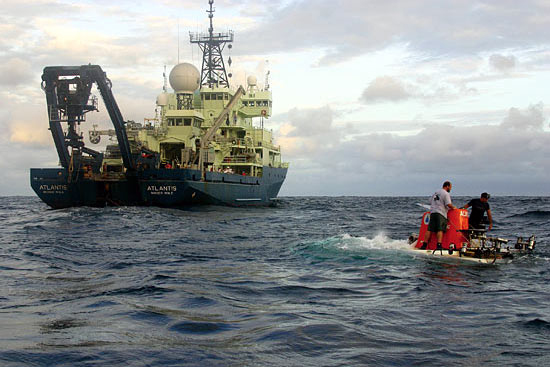
The R/V Atlantis, operated by the Woods Hole Oceanographic Institution, drafts 17 feet of water, has a cruising speed of 12 knots, and a cruising range of 17,280 nautical miles. Click image for a larger view.
Research Vessel Atlantis
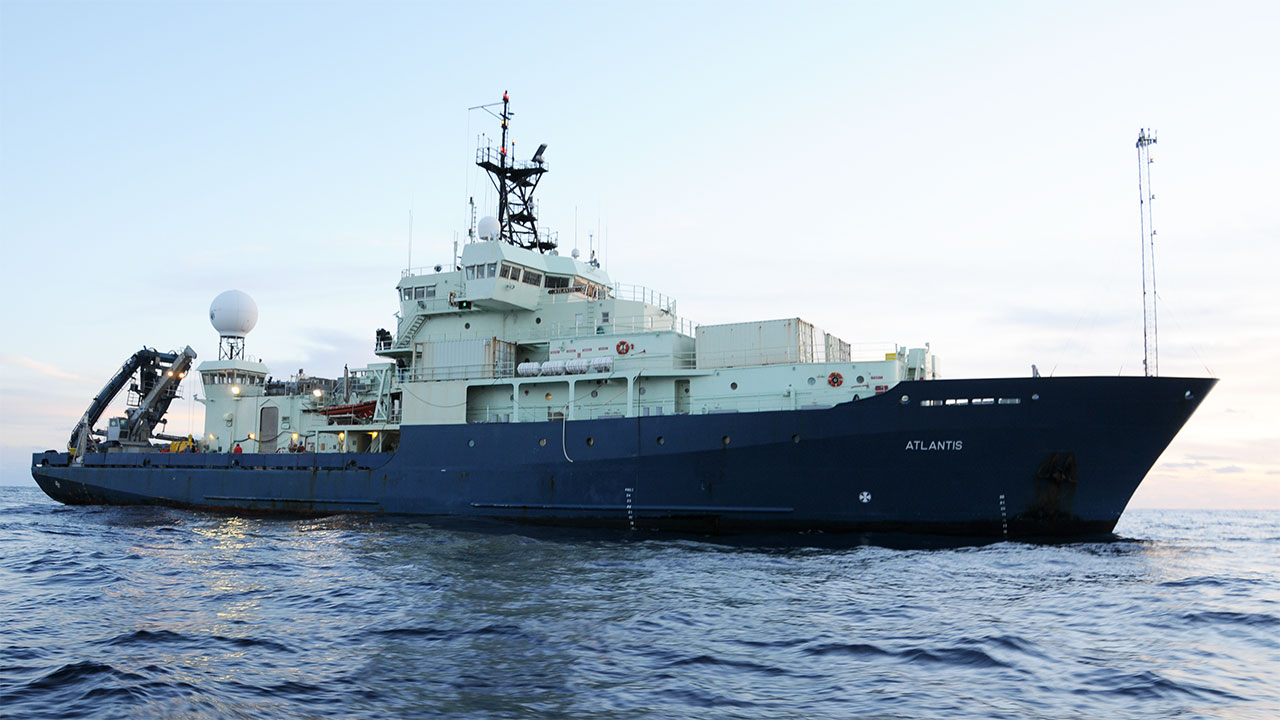
At 274 feet in length and displacing 3,510 tons, the Woods Hole Oceanographic Institution’s (WHOI’s) R/V Atlantis is designed as a general purpose research vessel. Built by Trinity Marine Groups Halter Marine Inc. of Pascagoula, Miss., WHOI launched the Atlantis in 1997.
The current Atlantis is the third in a line of distinguished research vessels. The first Atlantis —WHOI’s first research vessel—spanned 142 feet and sailed 600,000 miles from 1931 to 1966. After the first Atlantis retired, the 210-foot Atlantis II sailed more than a million miles from 1963 to 1996. The Atlantis supports the U.S. National Deep Submergence facility, as well as the submersible Alvin, the remotely operated vehicle (ROV) Jason and the towed vehicles Argo II and DSL 120.
The Atlantis can endure 60 days at sea with a cruising range of 17,280 nautical miles. It has a cruising speed of 12 knots and can reach a top speed of 15 knots. The Atlantis carries a complement of 23 officers and crew, 23 scientists, and 13 deep submergence pilots and technicians.
Science and Research Support
The Atlantis contains more than 3,500 square feet of laboratory space. The main lab is a large, open-space, general purpose lab directly accessible by the main deck that can accommodate a variety of shifting needs and equipment. The bio/analytical lab is isolated from the rest of the lab spaces to allow for sensitive equipment and temperature control. It allows scientists to handle specimens in a temperature-controlled environment. The hydro lab is located on the port side of the main deck and is used as a general purpose facility. One end of the lab is used as a maintenance area for the ROVs. Located near the Alvin hanger, the wet lab allows scientists to collect and analyze seawater samples in an uncontaminated, water-tight environment. Finally, scientists also have access to a well-equipped computer and electronics lab.
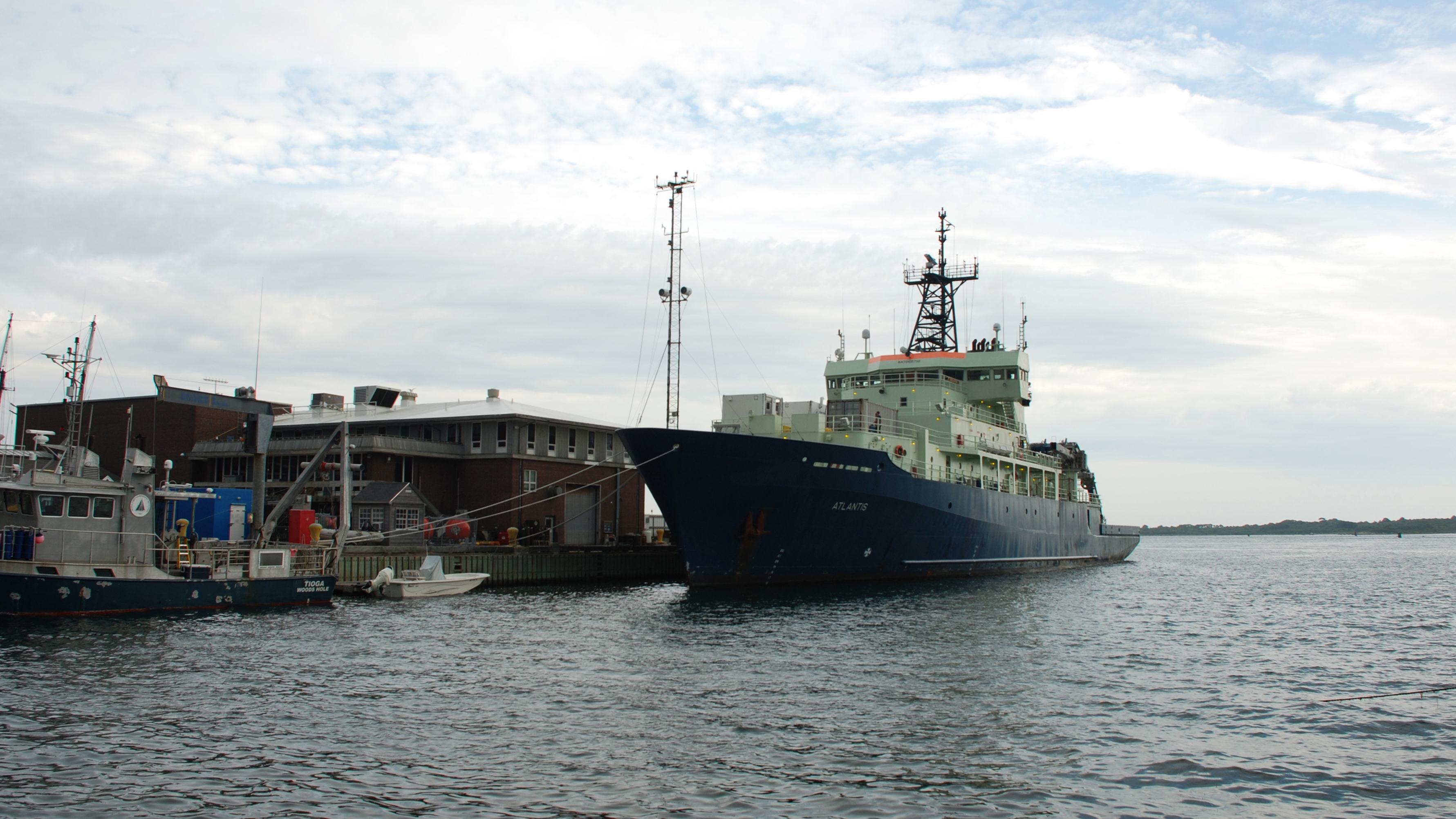
The R/V Atlantis at its home port of Woods Hole, Massachusetts. The ship is 274 feet in length and 52.5 feet at its widest point. Click image for a larger view.
Two storerooms allow for overhead stowage of large gear. Portable lab space also is available on the working decks. In addition, the submersible support crew has access to electrical and machine shops, and the main deck houses two hangars for Alvin and the ROVs.
The Atlantis also is equipped with a variety of permanent tools including a SeaBeam swath bathymetric sonar system, an expendable bathythermograph, an acoustic Doppler current profiler, a data logging and network system that incorporates meteorological, seawater and investigator-provided sensors, conventional echo sounders, a long-base line acoustic transponder navigation system, and a deionized distilled water system. The ship also houses a sophisticated computer system that connects the laboratories, staterooms and bridge. Moreover, a closed-circuit video system allows observers to remotely view the afterdeck, instrument deployment from the wet lab and the two winches below the main deck. Scientists also bring their own equipment onboard, the nature of which can vary widely depending on their mission.
Finally, the Atlantis includes sleeping quarters, a well-stocked galley, a lounge and a library of movies for guests. But the Atlantis is not cheap. Science teams should expect to pay about $25,000 each day the Atlantis and Alvin are at sea.
Integrated Computer Network
Two diesel 360-degree engines and a 1,180 horsepower jet bow thruster propel the ship.
The Atlantis features a variety of multi-purpose network computers for science use. Data can be transmitted via single-side band and VHF radio, weather facsimile, a satellite system known as INMARST, telex and email. Gyrocompasses and a global positioning system, both of which are advanced navigational equipment used to augment radar and paper charts, can accurately determine the ship’s position.
The Atlantis’ most distinguishing characteristic is its large, A-frame crane on the stern. The crane lifts Alvin off the deck and sets it down in the water, and also hauls it aboard when its work is completed. While Alvin explores the seabed, the Atlantis employs a positioning system that allows it to remain in one spot. Thrusters controlled by a global positioning satellite system compensate for wind and current.
Click here to learn more about the R/V Atlantis.
Click here for information on WHOI's Research and Marine Operations