


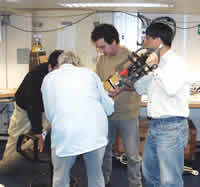
Deployment of the hydrophone: 1) Hydrophone being loaded into pressure case; Click image for larger view
Deploying a Hydrophone
Chris Fox
Principal Investigator
Sound in the Sea Project
NOAA Pacific Marine Environmental
Laboratory, Newport, Oregon
To deploy a hydrophone mooring, we must follow a specific set of steps. First, we must identify an area of the seafloor that is relatively flat for a 5- to 10-km diameter. This is necessary so that we can be certain of the length of mooring required to suspend the hydrophone into the overlying SOFAR channel.
Once a site has been identified, we measure the water properties using an eXpendible BathyThermograph (or XBT) and determine the precise depth of lowest sound speed (the axis of the SOFAR channel). Once we know the water depth and the depth that we want to suspend the hydrophone, we can construct a mooring of just the right length.
Next, we position the ship downwind 3-4 km and begin slowly moving toward our desired deployment site as we let out the mooring into the water. We let out a large yellow float, complete with strobe light, flag and floating line, which will help us recover the mooring next year.
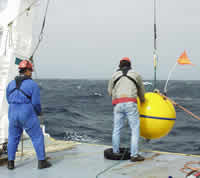
2) Deploying the float which will come to the surface when the instrument is recovered next year; Click image for larger view
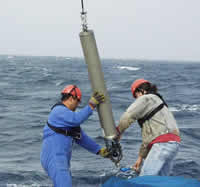
Then we release the hydrophone instrument, which has been checked and programmed to begin recording, usually the next day. Next, we let out 2,500 -4,500 meters of special mooring line design not to stretch or vibrate (strum).
Finally, we set out an acoustic release device that can be commanded to release the mooring and a large anchor. When the ship reaches the desired point, the anchor is released and the mooring is sent to the bottom to record for a year until we return to retrieve it.
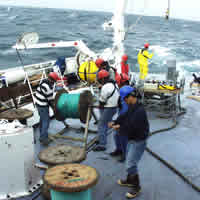
4) Paying out the mooring line between the hydrophone and anchor. Click image for larger view.
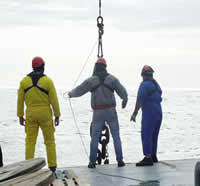
5) Kicking the anchor in. Click image for larger view.
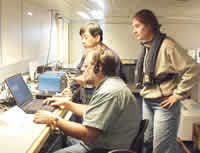
6) Chris Fox, Sara Bazin and Haru Matsumoto acoustically querying the instrument after deployment to verify its location. Click image for larger view.
Sign up for the Ocean Explorer E-mail Update List.