How have animals living only in caves adapted?
Animals living only in marine caves have adapted to environments with low light and often low levels of oxygen.
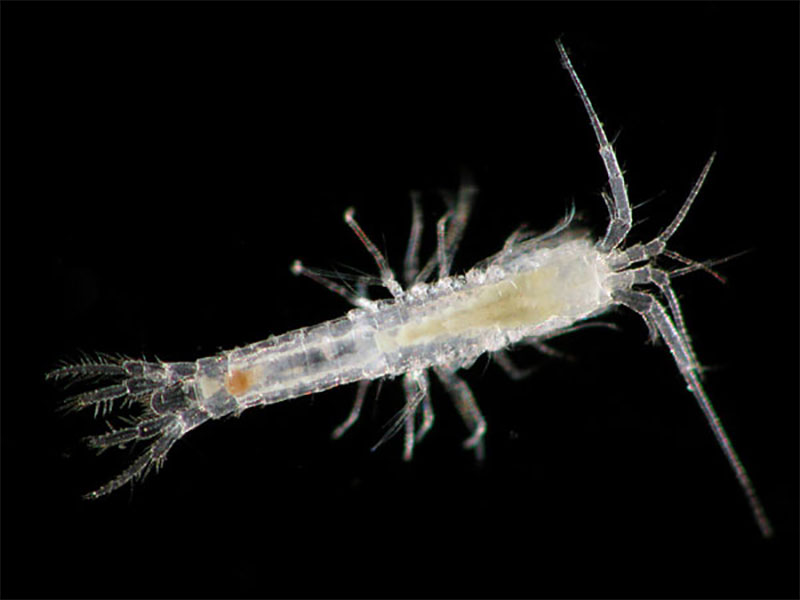
The crustacean order Mictacea is represented by only a single species, Mictocaris halope, that inhabits several sea water caves in Bermuda. Image courtesy of Tom Iliffe, Bermuda: Search for Deep Water Caves 2009. Download image (jpg, 41 KB).
Typical adaptations seen among animals that live exclusively in caves include:
- Lack of pigmentation
- Reduction in the size of eyes (or absence of eyes altogether)
- Development of sensory mechanisms that do not depend on light for detecting food or predators
Many of these animals also have adaptations that reduce the need for oxygen. This is because anchialine caves (or coastal caves flooded with seawater) tend to be oxygen-depleted due to a lack of photosynthesis and very limited water circulation. These adaptations may be behavioral, morphological, or physiological:
- Behavioral adaptations include swimming slowly or intermittently while searching for food and reduced territorial or antagonistic behavior.
- Morphological adaptations include increasing the size of sensory body parts that do not require light and may also include reducing energy requirements by eliminating unused body parts (e.g., eyes and pigments) and reducing the overall physical size of the organism.
- Physiological adaptations include lower metabolic rates and accumulation of lipids which contain about twice as much energy per gram as proteins or carbohydrates. Lipids also increase buoyancy and can reduce the energy required for swimming.
Adaptations do not happen because an animal “wants to adapt” or “needs to adapt.” Adaptations happen as random events, and if they provide an advantage, the organism is more likely to survive and reproduce than other organisms with these same adaptations.