


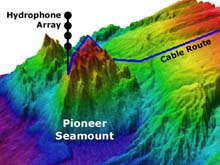
This map shows the location of the submarine cable off the central California coast that was being used for the Sound in the Sea Project. This cable stretched from Pillar Point Air Force Station to an underwater seamount (Pioneer Seamount) and was approximately 100 km long. A passive underwater hydrophone was installed on the seaward end of the cable. Data on recorded sounds was sent along the cable to a station on land for processing, then made available over the Internet. Click image for larger view.
Sounds in the Sea
August 27 to September 4, 2001
Update: A Cable connecting the hydrophone array on Pioneer Seamount to the shoreline was severed and it was decided not to repair the cable due to costs and the risk of disturbing the benthic environment. However NOAA does continue to pursue underwater acoustic experiments. For more information, please visit:
In late August, scientists sailed from San Francisco to Pioneer Seamount, off the coast of central California, and installed underwater hydrophones (known as an array). The hydrophones allow researchers to remotely monitor and record ocean sound to further their understanding of the sources and effects of ocean noise. The ocean sound data is now being transmitted live over the Internet.
Passive underwater acoustic monitoring allows the detection of a variety of deep-ocean processes at long distances. Some of the sound sources to be studied include earthquakes, volcanic eruptions, landslides, marine mammal and fish vocalizations, weather, and manmade noises. The experience gained from this effort may enable scientists to expand the hydrophone arrays to other underwater cables, that can be retrofitted. Ultimately, this could lead to a monitoring network capable of acoustic exploration throughout much of the global ocean.
Background information for this exploration can be found on the left side of the page. Daily updates are included below. More detailed logs of exploration activities can be found on the right.
Updates & Logs
Click images or links below for detailed mission logs.
 Apr 24, 2002 After a short period of inactivity, the hydrophone array is delivering data again. Read about the repair effort.
 Sep 2 Chief Scientist Chris Fox shares his summary observations in today's log entry. Read about the last few days and the team's successful deployment of the first civilian cabled hydrophone array. You can also
  listen to live audio or
  view a video of the installation (9.4 Mb) . Requires QuickTime
Sign up for the Ocean Explorer E-mail Update List.


