


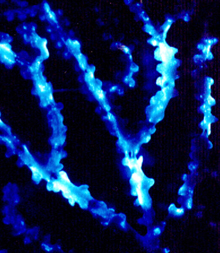
View a slide show of images from the Bioluminescence 2009: Living Light on the Deep-sea Floor exploration.
 Click image to view a slide show.
Bioluminescence 2009:
Living Light
on the Deep-sea Floor
July 20–30, 2009
Sudden blue flashes . . . Shooting beams of red light . . . An eerie green glow. These are just some of the surreal displays created by deep-sea animals that are bioluminescent, which means they can create and emit visible light. A fascinating phenomenon, bioluminescence is found in only a few species on land (e.g., fireflies), but it is common in all the world’s oceans. It has been estimated that 90% of the animals living in the pelagic (open ocean) water column are bioluminescent.
However, information on bioluminescence in the deep-sea benthos (organisms that live on the bottom) is sparse, due to the difficulty in getting live animals in trawls and dredges for study. Based on the few but varied deep-sea sessile (attached to a base, like corals or sea anemones) animals that are known to be bioluminescent, and the adaptations that have been discovered in the large eyes of some of the motile (able to move) predators on previous NOAA Office of Education and Research (OER) expeditions, it is likely that benthic bioluminescence is abundant and plays a significant role in animal interactions.
That's what the Bioluminescence 2009 cruise is about. On July 20, a science team will embark on an expedition of discovery on the research vessel Seward Johnson to study bioluminescence on the deep-sea floor off the Bahamas.
Led by Chief Scientist Tamara Frank (Harbor Branch Oceanographic Institution/Florida Atlantic University), Sönke Johnsen (Duke University), Edith Widder (Ocean Research & Conservation Association), Charles Messing (Nova Southeastern University), Steve Haddock (Monterey Bay Aquarium Research Institute), and other investigators will use their combined expertise in bioluminescence, taxonomy, visual ecology, imaging and molecular biology — together with the unique collecting capabilities of the Johnson-Sea-Link submersible — to explore the deep-sea benthic environment for undiscovered “living lights.”
You can access the Ocean Explorer Bioluminescence 2009 News Feed here: 
Updates & Logs
Click images or links below for detailed mission logs and updates.
 Mission Summary Read Chief Scientist Tamara Frank's summary of the remarkable discoveries made during this short but successful sea-floor exploration!
 July 29 Watch a gooseneck barnacle, nestled within a Gerardia, peer at the submersible as it
 Includes Video
 July 28 Experience bioluminescence as viewed from inside the Johnson-Sea-Link submersible. There are dozens of species on the sea floor, but it seems only a small fraction of them make light.
 July 27 The UV-sensitive crab, Gastroptychus spinifer, has large eyes for such a small animal. This particular crab was collected at around 600 m (1,969 ft) depth. Includes Video
 July 26 A school of Cuban dogfish sharks surrounds theEye-in-the-Sea, tearing at the bait and swimming in and out of the camera-system frame — just like a pack of playful puppies. Includes Video
 July 26 Edwin Link and a Deep-sea Mystery! What does a six-gill shark and an illuminated fishing lure have to do with the toppled EITS? Take your guess, then find out what the EITS caught on video.
  July 25 The Johnson-Sea-Link enables scientists to explore areas where literally no person has ventured due to the physical constraints of pressure and darkness. Includes Video
 July 24 Discovery! We report a new species — and possibly a new genus — of stalked crinoid, or sea lily, belonging to a family previously unknown in the western Atlantic Ocean. Includes Video
 July 23 Blue-water diving is a scuba technique used by scientists to investigate animals living suspended in the middle of the ocean. Includes Video
 July 22 Graduate student Gabby Barbarite has her first sub dive, and discovers a whole new environment: "Out of all the adventures in the world, I must say that journeying to the bottom of the ocean takes the gold!"
 July 21 Today's first dive is on a deep-water reef, called a lithoherm. Shaped like an upside-down ship’s hull, it runs hundreds of feet, north to south. Includes Video
  July 20 The expedition team has been hard at work, preparing equipment and setting up laboratories onboard the research vessel Seward Johnson as it steers toward the lithoherms west of the Little Bahamas Bank.


