


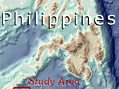




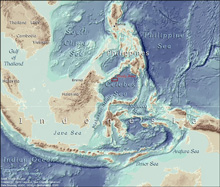
Lying just north of the equator, the Celebes Sea is the center of the most biologically diverse area of the world’s ocean. Our expedition will begin in the Port of Manila (top center) and take us south through the Sulu Sea to our study site, southeast of the Sulu Archipelago, where the bottom falls off abruptly to the sea floor thousands of meters below. In comparison to the size of the Celebes Sea (the 500-kilometer scale bar on the map would easily lie inside the basin), our study area is relatively small, but we hope that our discoveries will stimulate more extensive exploration and research in these fascinating ecosystems. Click image for larger view and image credit.
Exploring the Inner Space of the Celebes Sea 2007
September 27 – October 16, 2007
Our expedition takes us to unexplored waters south of the Philippine Islands, in search of the strange — and possibly unknown — fishes, jellyfish, squids, and shrimp that live in the dark deep waters of the Celebes Sea. Surrounded by much shallower ocean waters, the Celebes plunges to over 5,000 meters (m), and in these waters there may well be species that have evolved in isolation from other surrounding waters, waiting to be discovered with modern exploration tools.
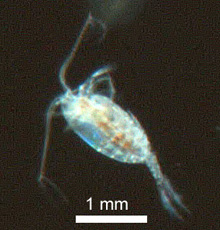
We’ll be diving in the middle of the richest marine environment on Earth — an area known as the “Coral Triangle” of Southeast Asia. This region, including the Philippines, Malaysia and Indonesia, is known to have the highest species diversity of shallow-water marine animals. The same may be true for deep-water creatures, but nobody knows yet. Using a remotely operate vehicle (ROV) that can dive to 3,000 m, we’ll get high-definition video and still pictures, and collect specimens to bring back for study. With multiple large trawl nets, we plan to collect even more samples. Baited cameras moored to the bottom will take photos and video of big animals attracted to the free meal. Up in the warm surface waters, we’ll go scuba diving to film and collect the delicate zooplankton we find there.
Our area of operation will be just to the southeast of the Sulu Islands, and we expect to spend two weeks working there. We will be on the research vessel BRP Hydrographer Presbitero, operated by the Philippines National Mapping and Resource Information Authority. (BRP is the acronym for Barko ng Republika ng Pilipinas, which identifies the ship as being from the Republic of the Philippines.) We will be joined by scientists from several Philippines universities and research agencies.
Working together with our colleagues from the Philippines, we’ll use all these samples, videos, images, and data to increase our understanding of the biological composition and the nature of the deep midwater environment of the Celebes Sea, and compare it with what is known about other deep-sea regions around the world.
RSS Feed:
You can access the Ocean Explorer Exploring the Inner Space of the Celebes Sea 2007 news feed here: 
 Mission Podcast:
Listen to an audio podcast from Chief Scientist Larry Madin as he introduces the science behind this mission.
Media Coverage:
MSNBC, Exotic Creatures Found in "Coral Triangle" 

Updates & Logs
Click images or links below for detailed mission logs. We will be receiving updates every couple of days by satellite phone from this expedition. Due to bandwidth limitations, high-resolution photos and video clips will not be available immediately but will be added after the mission concludes.
 Mission Summary Chief Scientist Larry Madin provides a mission summary, highlighting the diversity and abundance of life in the water
column of the Celebes Sea.
Mission Summary Chief Scientist Larry Madin provides a mission summary, highlighting the diversity and abundance of life in the water
column of the Celebes Sea. October 14 Sixty-one people on a ship designed for 40 work remarkably well together, as they finish taking samples and doing surveys in
the Celebes Sea.
October 14 Sixty-one people on a ship designed for 40 work remarkably well together, as they finish taking samples and doing surveys in
the Celebes Sea. October 13 Biologists from the Philippines play a key role in this mission, including their efforts in the hunt for zooplankton.
 October 12 One of the more unusual tools used during this mission is a planktonkreisel, a kind of "merry-go-round" that allows researchers to more easily observe plankton.
 October 10 Philippine Navy Seals and National Geographic TV
cinematographer Nick Caloyianis rescue a balky ROV.
October 10 Philippine Navy Seals and National Geographic TV
cinematographer Nick Caloyianis rescue a balky ROV.  October 8 Mission participants welcome guests from Tawi-Tawi and
Bangao and are entertained by the traditional Muslim dances of Southern Mindanao.
October 8 Mission participants welcome guests from Tawi-Tawi and
Bangao and are entertained by the traditional Muslim dances of Southern Mindanao.  October 7 Photographer Emory Kristof is unfazed as his $25,000 camera sinks to the bottom of the Celebes Sea.
  October 6 The expedition uses digital holographic imaging to study undisturbed marine plankton. Also, ROV operations begin.
 October 4 Terrorist groups, including one which is linked to Al Queda, lurk in Mindanao, so the mission is protected by Philippine Navy Seals.
 October 2 Anchors away! The ship sets sail and runs into high seas.
 September 30 As scientists set up their equipment, team members make a last-minute shopping trip for bait fish and other necessities.
 September 29 Caron de Mars organizes a test dive to check underwater camera equipment.
 September 27 The team prepares for departure by loading the ship and meeting with Philippine students.
For more information on this expedition, check out an Explorer Blog:
Gregory Stone's blog .


