


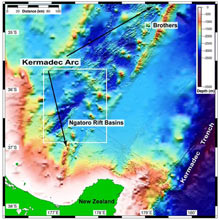
The cruise targets for the New Zealand American Submarine Ring of Fire 2007 (NZASRoF'07) expedition will be both the Brothers Volcano and the Ngatoro Rift Basins. The research vessel (R/V) Sonne will depart from Auckland, New Zealand, on July27 and return August 16. Bathymetry data are satellite-derived (bottom, 3,500 meter resolution); EM300 (top, along the arc, 30 meter resolution). Plate tectonic features are also indicated. Click image for larger view and image credit.
Mission Plan
Bob Embley
Chief Scientist
Geophysicist
NOAA Vents Program, PMEL – Newport, Oregon
Cornel E.J. de Ronde
Geologist
GNS Science
Lower Hutt, New Zealand
 NOAA Podcast:
Learn what Bob Embley hopes to discover during this expedition with a video or audio podcast on the mission.
The research vessel (R/V) Sonne will depart Auckland, New Zealand, on July 28 with an international group of scientists and engineers on board to explore a large active submarine volcano 250 nautical miles north of New Zealand’s North Island. The autonomous benthic explorer (ABE) robotic mapping vehicle will conduct near-bottom surveys down to more than a half a mile in depth, mapping the sea floor and its properties in detail never before seen on this type of sea floor volcano. As ABE surveys from 200 to 300 feet above the sea floor, untethered from the R/V Sonne, its sensors will also map the chemical and temperature anomalies in the overlying water column generated by the very vigorous hydrothermal systems at Brothers.
While ABE is surveying Brothers Volcano, the Sonne will investigate unexplored deep rifts to the west and southwest for signs of geothermal and volcanic activity. Test dives will be conducted with a new remotely operated vehicle, which is being used for the first time by engineers from the GEOMAR Institute of Germany, led by Thomas Kuhn and Chief Scientist Colin W. Devey.
The expedition is sponsored by the NOAA Office of Ocean Exploration (OE), the Geological and Nuclear Science Institute in New Zealand, and the Leibniz Institute of Marine Sciences, IFM-GEOMAR, of Germany. ABE is operated by the National Deep Submergence Operating Group at Woods Hole Oceanographic Institution.
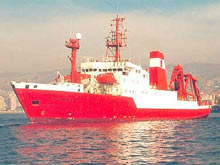
The R/V Sonne is a multi-purpose research vessel that was built in 1969 as a stern trawler and modified as a research vessel in 1977. Lengthened and modernized in 1991, the Sonne is presently owned and operated by RF Reedereigemeinschaft Forschungsschiffahrt GmbH of Bremen, Germany. At 98 meters (more than 321 feet) in length and with displacement of 4,734 metric tons, it is capable of world-wide operation with up to 25 scientists. Click image for larger view and image credit.
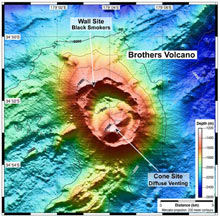
Brothers Volcano is one of the most geothermally active arc volcanoes yet discovered. It has at least two active hydrothermal systems belching out fluids as hot as 300º C (572º F). The high-resolution EM300 bathymetry data (shown here) are proprietary, courtesy of New Zealand National Institute of Water and Atmospheric Research. Data resolution is about 25 meters. Click image for larger view and image credit.
By the end of the expedition, we hope to have a map of the 4.3 x 3.3 kilometer (about 2 1/2 x 2 mile) summit of the volcano that will show sea-floor features as small as a few meters on a side and reveal new insights into the underlying structure and the flux of gas and metals emitted by its hydrothermal systems.
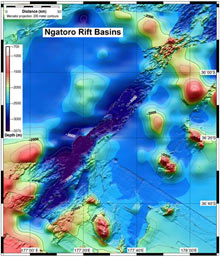
During NZASRoF'07 some deep troughs to the west of the active line of arc volcanoes will be explored (Ngatoro Rift basins, for example). These rifts are forming as the Pacific plate descends into the Kermadec Trench and “pulls” the crust to the east, thinning the ocean crust and opening deep tears, such as the Ngatoro Rift basins. SeaBeam bathymetry provided by GNS. 50-meter grid-cell size. Click image for larger view and image credit.
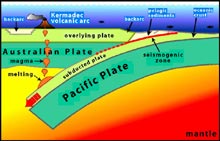
This illustration shows the Pacific plate in the east colliding with the Australian plate in the west. A consequence of this collision is subduction with the down going slab comprised of oceanic crust, or lithosphere, and a thin veneer of pelagic sediment. This causes extension behind the subduction zone, which is represented by backarc basins forming behind the arc front. At certain depths, usually around 200 kilometers (about 100 nautical miles), there is melting of the subducted materials. The melting produces magmas that rise buoyantly to pond in the overlying mantle wedge, and periodically erupt on Earth's surface as lavas, forming arc volcanoes. Click image for larger view and image credit.
We will also be exploring some deep troughs to the west of the active line of arc volcanoes (Ngatoro rifts, for example). These rifts are forming as the Pacific plate descends into the Kermadec Trench and “pulls” the crust to the east, thinning the ocean crust and opening deep tears, such as the Ngatoro Rift basins. This “rifting” also increases the flow of heat from the underlying mantle of the earth, sometimes resulting in increased geothermal activity and volcanic activity. This will be the first systematic exploration for geothermal activity in the backarc basin of the Kermadec subduction zone.
If the tests of the new GEOMAR remotely operated vehicle (ROV) Quest 7 are successful during the first half of the expedition, we will make dives to features identified by the ABE surveys at Brothers and to newly discovered geothermal activity in the backarc basin.


