






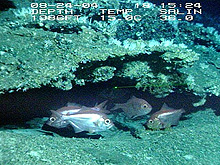
A large group of red bream (Beryx decadactylus) hides under a ledge. This deep-water fish may soon become popular with commercial fishermen. Click image for larger view.
Field vs. the Lab: The Graduate Students' Perspective
August 28, 2004
Kelly Filer
Graduate Student
College of Charleston
Ask any of the graduate students on the Estuary to the Abyss Expedition what their feeling is about being here, and you’ll get the same answer: we'd rather be in the middle of the Gulf Stream than back in a lab in Charleston. The experience completely outweighs any of the annoyances of living on a research vessel for almost two weeks. The close quarters, cold rooms, and odd sleep schedules pale in comparison to the wonders of the expedition experience.
The case for the field
At this point, every graduate student on the cruise has visited the bottom of the ocean
in the Johnson-Sea-Link II. We are also learning about the other
sample collection methods used to study fauna in both the pelagic
zone and the deep sea, as well as what can go wrong when using them. Personally,
I’ve never had the chance to see how a pipe dredge or beam trawl
collects organisms from the ocean bottom, or how easily one
of these pieces of equipment can get caught on an object on
the bottom and find a new home there. For all of the scientists on this
expedition, the chance to participate in an activity where the sole purpose
is to find out what is "down there" is a welcome opportunity.
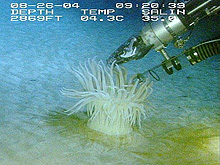
A very large anemone just before it was collected by the Johnson-Sea-Link II. Click image for larger view.
Of course, the most exciting part has been going down to the ocean floor in the submersible and seeing all of the amazing animals that have been brought back from each dive. As soon as the buckets of samples are taken off the sub and put on a table in the lab, we crowd around and try to get pictures of the organisms, and maybe have a chance to pick one up.
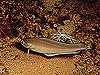
The only thing that has disappointed the "fish people" so far is that we have seen very few fish on our dives, and have collected even fewer (though we have started to see more in the last few dives). Those few fish that we brought up -- e.g., the rare goosefish collected Thursday at nearly 3,000 ft deep -- caught the attention of all of the scientists. Then there was the head-sized anemone, also caught Thursday, and the slit shell snails brought up during one of the first dives. These and other remarkable invertebrates almost make up for the lack of fish brought to the surface. The things we have seen have blown us all away.
Then, there are some days, like today, when we can only sit and wait to see what the weather, specifically Tropical Storm Gaston, wants to do. Obviously, the submersible has weather limits and will not dive if the waves are more than 6 ft. We are now playing the "waiting game" with the 10- to 12-ft seas from Gaston and watching to see if the waves will subside enough for a dive. We have even had to change course and go to a site that was not on our planned cruise itinerary. So, as of early Saturday afternoon, one of the graduate students, Christina Ralph, whose first dive was cut very short because of some mechanical problems, is still waiting for her first full dive. This, of course, is the biggest hindrance to work at sea, and also the most frustrating, especially when precious dive time is on the line.
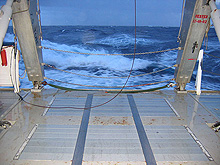
Sea conditions on Saturday morning, resulting from Tropical Storm Gaston, delayed submersible dives for at least another day. Click image for larger view.
The case for the lab
We cannot spend our whole graduate careers out on the ocean. We will have to get back to the lab, at some point -- and none of us will be disappointed to be back. Marine science is definitely a balance between field work and time spent in the lab. For me, this cruise has been very exciting, but has not yielded any sightings of barrelfish, the fish I’m studying for my master’s thesis. We still have a few more days out here, so I have not lost hope. Even if we were to see the barrelfish on one of our dives, however, the lab is still where most of the research on this species will be done. I’ve got many hours ahead of me, ageing fish by their otoliths (ear bones) and looking at histological slides of their gonads.
Likewise, the other graduate students have already spent plenty of time back in Charleston, working on their research projects. Cara Fiore, who was able to boost her collection of deep-sea sponges on this trip, must go back to the lab and identify everything that inhabits those sponges. Christina Ralph and Sarah Griffin, who have spent their time in the lab thus far watching tapes of submersible dives from previous cruises, trying to describe the fish and invertebrate communities, respectively, have now had the chance to see first hand the things that they, until now, have only seen on video. Zeb Schobernd, who has been analyzing commercial and recreational catch data for serranid fishes, has been out here, like me, hoping to catch a glimpse of some of the fish he has been studying for over a year. Serranid sighting or not, he will be back in the lab analyzing data after this exploratory cruise is done.
In conclusion
The synthesis of these two types of research -- laboratory and
field work -- will enable all of us to learn as much as we can about our
thesis topics and continue on in our scientific careers.
Sign up for the Ocean Explorer E-mail Update List.


