


Photo & Video Log
This page contains photos and videos taken during the
Operation Deep Scope 2004: Seeing with "New Eyes" Expedition on the R/V Seward Johnson II during August 7 - August 17, 2004. Click on any image to view
a larger version and for additional information.
If a movie camera icon
 is
present, a video can be viewed by clicking on the image. Other
video formats are available on the linked pages. If a Podcast icon
is
present, a video can be viewed by clicking on the image. Other
video formats are available on the linked pages. If a Podcast icon  is
present, a video or audio file is available for download or you can subscribe to the RSS Podcast Feed.
is
present, a video or audio file is available for download or you can subscribe to the RSS Podcast Feed. 
If a slideshow icon  is
present, a visual log of exploration images can be viewed. You can scroll
through them one by one, or select the play button for an automatic slideshow.
is
present, a visual log of exploration images can be viewed. You can scroll
through them one by one, or select the play button for an automatic slideshow.
(HR) = "High Resolution" images available.
Video & Slideshows
August 17
Bamboo coral were revealed to be propagating bioluminescence up their branches. (mp4, 3.2 MB)
August 17
The Eye-In-The-Sea camera captures giant isopods and a six-gill shark. (mp4, 4.9 MB)
August 16
A fluorescent greeneye fish is discovered sunder the submersible's blue-filtered headlights. (mp4, 2.9 MB)
August 14
View the peeper recovery and sampling process. (mp4, 5.6 MB)
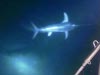
August 12
A strange encounter with a swordfish at 1,760 ft below the surface. (mp4, 1.5 MB)
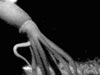
August 11
A Mastigoteuthis squid, approximately six ft in length over 1,600 ft below the surface. (mp4, 1.3 MB)
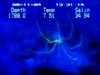
August 10
Video shot over 1,700 ft down in the Gulf of Mexico, shows the fluorescence of a benthic sea spider. (mp4, 2.8 MB)
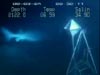
August 9
A six-gill shark was spotted over 2,100 ft below the surface. (mp4, 2.5 MB)
August 8
Deploying the Eye-in-the-Sea (EITS) on the edge of a brine pool, at over 2,100 ft. (Quicktime, 1.1 Mb.)
Images
Summary
The sun sets on the last night of our exploration.
Summary
The deep seafloor holds many beautiful scenes.
Summary
The biotechnological potential of this red fluorescent starfish is one of the most promising animals studied on this mission.
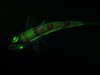
August 16
Note the green fluorescence of the eyes of this shortnose greeneye fish. The submersible team collected the specimen for optical studies in the ship’s onboard laboratory. (HR)
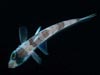
August 16
Under white light the green lenses of this 6-inch greeneye fish are still quite apparent. (HR)
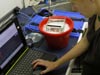
August 16
Alison prepares the spectrometer, an instrument that measures the wavelengths in light, to study the absorption and reflectance properties of the fish’s fluorescent lens. (HR)
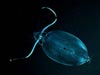
August 15
Caranchid squid. Open water divers can more easily observe these creatures with polarizing filters. (HR)
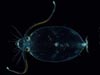
August 15
Caranchid squid. Open water divers can more easily observe these creatures with polarizing filters. (HR)
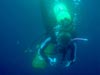
August 15
Blue water divers use glass jars to capture gelatinous specimens for further study in the ship’s laboratory. (HR)
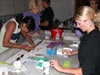
August 14
Members of the Deep Scope science party assist Sharmishtha to quickly process the sediment profile peepers. (HR)
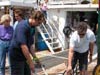
August 14
Seconds after the peepers reached the surface they were removed from the submersible basket and rinsed with seawater. (HR)
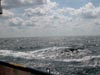
August 13
Rough seas in the Gulf of Mexico. (HR)
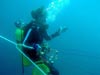
August 12
Scuba divers enter the mid-water realm to collect gelatinous creatures. (HR)
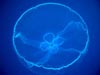
August 12
A jellyfish picture was taken by mid-water divers studying how these creatures adapt to living in areas where background light is in a constant state of flux. (HR)
August 12
A mid-water gelatinous mollusk seen using and then removes a polarizing analyzer filter. (HR)
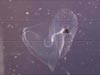
August 12
A mid-water gelatinous mollusk seen using polarized light. (HR)

August 11
If you lived at the bottom of the ocean, this is how your world would appear.
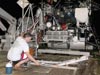
August 11
A few members of the science party worked to re-engineer the optical jelly on the Eye-In-The-Sea. (HR)
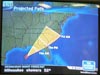
August 11
Tropical Storm Bonnie makes her way across the Gulf of Mexico, with Hurricane Charley a few days behind. (HR)
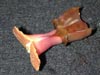
August 10
This Top portion of a tubeworm from the Brine Pool, photographed with white light. (HR)
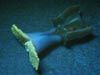
August 10
This Top portion of a tubeworm from the Brine Pool, photographed with blue light to stimulate fluorescence. (HR)
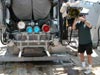
August 10
To make fluorescent observations, the Johnson-Sea-Link is modified by placing blue filters on the submersible’s two 400W HMI lamps. (HR)
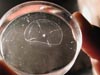
August 10
Jellyfish photographed with white light (above), and with blue light to stimulate fluorescence (below). (HR)
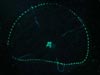
August 10
Jellyfish photographed with white light (above), and with blue light to stimulate fluorescence (below). (HR)
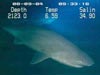
August 9
This Sixgill shark was captured on video this morning when the team dove to recover the Eye-In-The-Sea camera system
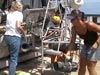
August 9
Tammy Frank and Nicole McMullen load baited benthic traps
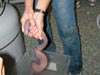
August 9
Dr. Frank holds a hagfish caught in one of the benthic traps. (HR)
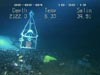
August 8
The Eye-In-The-Sea deployed on the edge of the brine pool
August 8
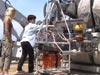
Dr. Edie Widder inspects the Eye-In-The-Sea
August 8
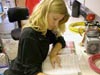
Erika Heine begins programming the Eye-In-The-Sea.
August 7
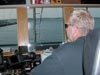
Captain Mike Schoeller on the bridge the morning of our departure.
August 7
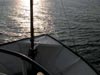
The Seward Johnson II heads into the Gulf of Mexico to begin dive operations. Rough seas lie ahead.
August 7
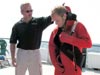
The survival (aka Gumby) suit protects from hypothermia.


