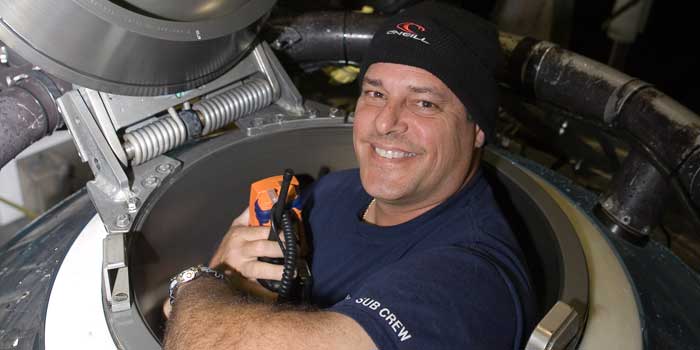
Meet Hugo Marrero
Hugo Marrero is a submersible pilot for Harbor Branch Oceanographic Insitute. Read the full text of Hugo's interview below to learn more about his job.
Video
Hear Hugo shares his experiences and the path that led him here. Download (mp4, 442 MB).
View transcriptAbout the Job
What is your title?
Submersible Pilot / Electronics Technician
Where do you work?
Harbor Branch Oceanographic Institution, Inc. Fort Pierce, FL.
Do you travel often?
Working in oceanographic research requires a lot of traveling as your job is mostly offshore. However, there is much work to be done in the office and at the shop before and after each expedition.
What are the educational requirements for your job?
My job requires a broad knowledge in several areas. To be able to effectively maintain the complex electronic systems aboard the submersible an Associate Degree in Electronics is the minimum education requirement. In addition it requires knowledge in hydraulics, pneumatic systems, navigation, boat handling and many other skills.
What is the salary range for someone with your type of job?
The salary range can vary depending on how much time you spend at sea. The highest I ever made at Harbor Branch is around $50K / year after spending approximately 160 days at sea.
How many hours do you work per week?
On shore, we work normal 40 hour weeks. At sea there is no set time, one day you may just work 4 to 6 hours do to weather and the next day you may work 20 hours. At sea the average is 88 hours a week.
Job Duties
Tell us about your research and the types of things you do.
My job is primarily to help the scientists do their research in an efficient and safe manner. As a pilot and technician for the sub, I am responsible for the submersible’s readiness prior to every dive, and to take the scientists underwater and back to the surface safely. I also ensure that all the science gear that goes in the sub for each dive is in proper operating condition prior to each and every dive. This simplifies the work load for the scientist who can concentrate in his research without worrying about the intricacies of operating and maintaining a submersible. During the dive I operate most of the science collection equipment, the video camera(s), digital Still Photo Camera(s), and continuously monitor the life support systems.
What is the most fascinating thing you have ever seen or done?
That is a tough question, as almost every dive is fascinating to me and each mission has its own unique challenges. However, I will never forget the time when we dove through a mud volcano in the Gulf of Mexico searching for a thermistor that a scientist had left the previous year. This instrument is only a few inches in length and it was attached to a buoy through a 10 ft line. During the year that the instrument was left in the bottom, the mud volcano was quite active and it had buried most of it in the sediment. When we came to look for it we had to do search patterns throughout the bottom right through the mud flow, which made it almost impossible to see. When we were resigned to give up the search for the instrument we found the very tip of the marker buoy at the bottom! This meant that the thermistor was buried more than 10 ft in sediment. Luckily we were able to retrieve it and the scientist got his data.
What are the personal rewards of your work?
My personal reward is the satisfaction that comes by doing something I have passion for and to be able to contribute to the success of the mission. I consider myself very fortunate as I know I have experienced things that only a handful of humans have ever experienced.
How does your work benefit the public?
By providing the scientists with the tools they need to make their research more effective my work is a small but important contribution to the understanding of our planet’s marine species and marine education in general.
What else could someone with your background do?
With my current education in electronics I have worked in the following fields prior to joining Harbor Branch:
Electronics Technician for an Instrument Manufacturer;
Biomedical Technician;
Field Service Engineer in the Semiconductor Industry;
Maintenance Technician for Intel;
Tourist Submarine Pilot & Electronics Technician;
Instrument Technician at a Power Plant.
About Hugo
What sparked your initial interest in ocean sciences?
My initial interest in Ocean Sciences began at around 15 years of age while still living in Puerto Rico. A friend once brought a Skin Diver magazine to school and I was hooked up.
Who influenced you or encouraged you the most?
I was always fascinated by Jacques Cousteau’s expeditions around the world. He was definitely a great influence in my childhood.
Looking back, was there anything you would have done differently in your education or career journey?
I would have studied Marine Biology instead of electronics.
What obstacles did you encounter along the way?
Most of the obstacles that I encountered along the way were economic limitations and limited access to good counseling when I graduated from high school. Today, with the advent of the Internet, things would have probably been much different.
What are your hobbies?
Photography, fishing, boating, hiking, traveling, reading, electronics.
Career Timeline
Interests in Elementary School:
Baseball, basketball, drawing, card collecting.
Beginning of Interest in Marine Sciences:
During Middle School Years while watching Jacques Cousteau’s Documentaries.
First Marine Science Class:
1990 at Santa Barbara City College.
Degrees:
Associate Degree in Electrical Engineering / University of Puerto Rico.
Certificate in Marine Technology / Santa Barbara City College.
First Career-related Job:
Atlantis Submarines Hawaii / Tourist Submarine Pilot.
Employment Journey/Career Transitions:
USCG Licensed Captain for vessels of up to 50 Tons.
Licensed Yacht Broker in the State of Florida.