
back banner
back button
spacer
ocean explorer home pageNOAA home page
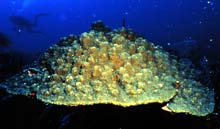
Platform Coral

The Tortugas area has the highest coral reef coverage in the Florida Keys.

Tortugas Ecological Reserve ProfileDescription

The Tortugas Ecological Reserve is split into a northern and southern portion. The 2001 Sustainable Seas Expeditions will focus on the northern portion of the Reserve, which is located approximately 75 nautical miles west of Key West and was implemented as a no-take Ecological Reserve on July 1, 2001. Located at the convergence of the Gulf of Mexico, the Atlantic Ocean and the Caribbean Sea, the Tortugas is an important measure for the health of these three marine environments.

This area of convergence also makes the Tortugas a critical area for spawning marine organisms. Larvae spawned in the Tortugas are carried by various ocean currents along the Florida Keys and upon meeting the Gulf Stream can be carried as far north as the Carolinas.

The area is characterized by the highest percent living coral cover in the Florida Keys and represents one of the most pristine coral reef areas in the continental United States. The remoteness of the Tortugas has been its saving grace and has contributed to its high water quality, low incidence of coral disease, and overall healthy reef environment. The crystal clear waters in Tortugas north range in depth from forty to 150 ft and encompass the shallow reef areas of the Tortugas Bank, an area known as Sherwood Forest, and the Pinnacles.
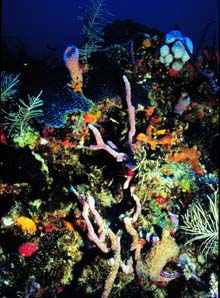


Colorful Reef Scene

The Tortugas contain the most pristine coral habitat in the continental United States.

Research and Education Objectives
  • International Maritime Organization anchorage area survey
  • Coral disease surveys
  • Fish counts


Habitats
  • Sand flats
  • Soft sediment
  • Bank reefs
  • Deep rocky reefs
  • Patch reefs
  • Drowned reefs
  • Pinnacles
  • Hard bottom
  • Algal sponge communities
  • Submarine canyons


Black Coral

Black coral can be found in the Tortugas Ecological Reserve.

Key Species
  • Grouper
    • Goliath
    • Red
    • Black
    • Snowy
    • Tiger
  • Snapper
    • Yellowtail
    • Mutton
    • Grey
    • Cubera
    • Dog
  • Sea turtles
    • Loggerhead
    • Green
    • Kemps ridley
    • Leatherbacks
    • Hawksbill
  • Spotted eagle rays
  • Sharks
    • Bull
    • Grey reef
    • Nurse
    • Lemon
    • Sandbar
    • Blacktip
  • Corals
    • Includes every variety of soft and hard Caribbean corals
  • Black coral
  • Sponges
  • Crinoids
  • Reef fish


Map of the Tortugas Ecological Reserve

A location map for the Tortugas Ecological Reserve. Click for a larger view.

Protected Area
  • Tortugas North: 90 square nautical miles
  • Tortugas South 50 square nautical miles
  • Federal areas designated March 8, 2001
  • State areas designated April 24, 2001
  • Implementation July 1, 2001.
  • 100% no-take requiring a no cost, no paper-work permit for entry


Reef formation in Sherwood Forest

Sherwood Forest is a unique area within the reserve distinguished by plating coral coverage.

Interesting Facts about the Tortugas
  • The Tortugas is a remote location with the highest coral coverage in the Florida Keys and is located at the convergence of the Gulf of Mexico, Atlantic Ocean, and Caribbean Sea.
  • The current patterns in the Tortugas interact with the Gulf and Atlantic portions of the Gulf Stream making it a critical area for spawning marine life.
  • The Tortugas contains the most pristine coral habitat in the continental United States.
  • The Tortugas Ecological Reserve was designated through a Working Group process involving a variety of stake-holder groups including commercial and recreational fishermen, environmentalists, government agencies, and concerned citizens who came to 100% consensus on a set of boundaries and regulations for the Reserve.
  • The Tortugas Ecological Reserve is the largest fully protected no-take marine area in the United a States.
  • Sherwood Forest, a unique area located in the northwestern portion of the Ecological Reserve, was discovered by a local dive operator and is distinguished by a plating coral coverage, which has created a false bottom several feet above the ocean floor.

(top)


E-mail Updates | User Survey | Report Error On This Page | Site Index | Contact Us
Revised July 12, 2005 by the Ocean Explorer Webmaster
National Oceanic and Atmospheric Administration | U.S. Department of Commerce
NOAA Logo Commerce Logo
http://oceanexplorer.noaa.gov/explorations/islands01/background/islands/sup3_tortugas.html