Photo, Audio & Video Log
This page contains photos and videos regarding the
INSPIRE: Chile Margin 2010 exploration taking place this year from February 24 to March 17. Click on any image to view
a larger version and for additional information.

If a movie camera icon
is
present, a video can be viewed by clicking on the image. Multiple
video formats are available on the linked pages. If a Podcast icon
is
present, a video or audio file is available for download or you can subscribe to the RSS Podcast Feed. 
If a slideshow icon
is
present, a visual log of exploration images can be viewed. You can scroll
through them one by one, or select the play button for an automatic slideshow.
(HR) = "High Resolution" images available.
Videos &
Slideshows

March 8 Log
Multicore video footage from the seafloor of swimming sea cucumbers!

March 1 Log
Listen to members of the INSPIRE crew sing their original composition, "Plumes: Nobody Knows."

February 28
Video taken from the seafloor at 2,600 m depth, as the multicorer lands and takes a sediment sample of deep sea fauna.

Exploration
This animation shows how ABE is used to find and then photograph sites of hydrothermal activity.
Images

Mission Summary
Sometimes the little parts are not only pretty but can tell us about the life history of the animals which we collect.

Mission Summary
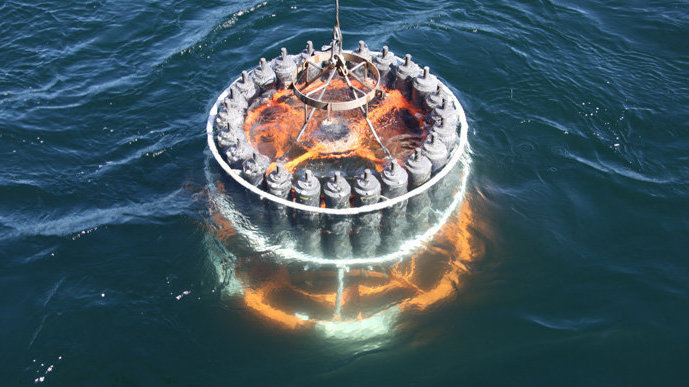
Our CTD was consistently our most successful instrument; we put it over the side at all of the sites we visited.

Mission Summary
A microbial mat on the left and carbonate rocks on the right: some of the first images of what this Chilean methane seep looks like.

Mission Summary
Rosa Leon Zayas forcing pressure into her chambers, which allows the microbes to survive for years to come.

Mission Summary
The science party of INSPIRE: Chile Margin 2010.

April 12
The deck of the R/V Melville was empty for only a few minutes before it was loaded up for the next cruise.

March 14
Rosa Leon Zayas works hard to organize water filtration.

March 14
Transferring water to garbage cans for filtration.

March 14
The trench team. From left to right: Ally, Rosa, Christina, Monica, Ashlee.

March 13
Biologists/foragers waist-deep in mud and digging through the contents of a trawl.

March 13
Ashlee Henig and her new friend “Patrick,” after the starfish was rescued from the scavenging biologists.

March 13
Ben Grupe imitates the crooked bear-shaped map created after a biologist designed our mapping survey.

March 12
Empty cores from the multicorer.

March 12
One of the irreparably damaged triggers.

March 12
Jim and Brian, our amazing res-techs; there is no problem they can’t solve.

March 12
Sabrina, engineer and trigger fabricator extraordinaire.

March 12
Success! Bringing mud aboard in the multicorer.

March 9
Damaged University of Concepción Marine Laboratory in Dichato, Chile.

March 9
The research vessel Kay Kay II, belonging to the University of Concepcion.

March 8 Log
Scientists and research techs at the multicore video monitors.

March 8 Log
Alexis Pasulka and Christina Tanner taking water samples from a sediment core.

March 8 Log
Our time together was too short, my Teflon friend.

March 8 Log
My new means of taking samples.

March 8 Log
The abyss. You can stare at it, and it just stares back.

March 7 Log
Gone, Baby, Gone.

March 7 Log
The coolest place on Earth?

March 6 Log
ABE gets ready for his final dive.

March 6 Log
ABE's empty cradle on the starboard deck of the R/V Melville.

March 6 Log
Stephanie shows Harold around the lab.

March 6 Log
Ben shows Harold how the worms feel.

March 6 Log
Monica and Harold visit ABE.

March 5 Log
This is what we didn’t want to see when we took a sample with the multiple corer.

March 5 Log
Javier preparing the first trawl for its inaugural voyage to the bottom of the ocean.

March 5 Log
One of the many albatross which have been keeping us company.

March 5 Log
Multi-core being brought up on deck.

March 5 Log
Alexis Pasulka, Tim Shank, Ben Grupe, and Rosa León-Zayas taking sediments samples from one of the cores.

March 5 Log
Christina Tanner, Ben Grupe and Rosa León-Zayas composing “Have a little faith."

March 4 Log
Scientists in the main lab get ready to watch live video of the seafloor.

March 4 Log
Ashlee Henig (right) discusses study locations with fellow grad student Monica Heintz at the map table.

March 4 Log
Members of the ABE crew from Woods Hole Oceanographic Institution prepare ABE for a deployment.

March 2 Log
Ben Grupe begins to prepare the CTD bottles for deployment.

March 2 Log
This graph shows the optical backscatter data from the second tow-yo above a spreading center.

March 2 Log
Several echinoderms can be seen in this picture taken by a video camera attached to the bottom of the multi-core.

March 1 Log
A core full of deep-sea mud from 2,600 meters.

March 1 Log
Small bivalve sorted from the deep-sea mud core sample on board the ship.

March 1 Log
Christina Tanner working on board R/V Melville during the INSPIRE cruise.

February 28 Log
Ben Maurer works splicing the electronics into the winch cable.

February 28 Log
The multi-core before its first dive.

February 28 Log
A picture of the seafloor 2,600 m below the boat.

February 27 Log
From left to right: Fernando, Francisco, Stephanie Mendes, Ives Melville, Javier.

February 27 Log
We saw whales!

February 27 Log
Stephanie Mendes working in the radioactive isotope van.

February 26 Log
Alexis Pasulka prepares her microscope for the cruise.

February 26 Log
Chris German shows the class a plume MAPR.

February 26 Log
Scientists stand on the upper deck with life jackets during an abandon ship drill.

February 25 Log
The R/V Melville.

February 25 Log
Graduate students Danny Richter and Ben Grupe in the "bubble."

February 25 Log
Sharing space in the lab.

February 25 Log
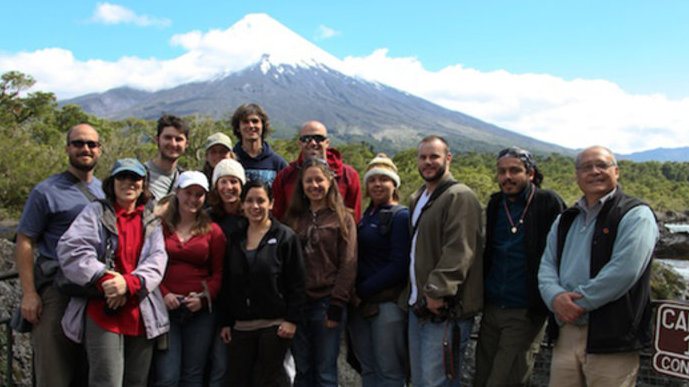
At the Rio Petrohue at the foot of Volcan Osorno.

Biodiversity
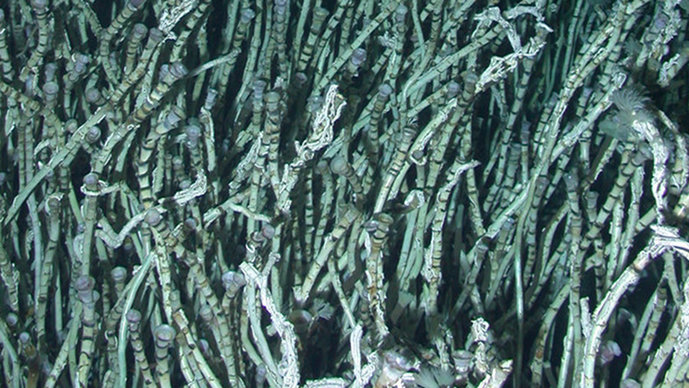
Extensive beds of siboglinid polychaetes provide a habitat for many animals.

Biodiversity
Incredible diversity lies in small animals which live in and on the sediment.

Biodiversity
A frenulate, now known to be within the family Siboglinidae and a type of polychaete.

Biodiversity
This is an example of the fauna which lives at methane seeps off of Chile.

Methane
Methane is composed of one carbon atom surrounded by four hydrogen atoms.

Methane
Cluster of anaerobic methane consuming archaea (red) and sulfate reducing bacteria (green).

Methane
A close up of a group of Bathymodiolin mussels from a methane seep.

Methane
A methane hydrate mound on the seafloor.

Geology
Map of the Southeast Pacific Ocean and South American continent showing the Chile rise spreading center

Geology
Schematic cross-section through the spreading center, subduction zone, and South American continent.

Geology
Cartoon cross-section through a spreading ridge axis showing several components of a hydrothermal vent system.

Geology
Methane gas bubbling up from sediments at a seep area.

Sea Floor Habitats
A tube core (8 cm diameter) collected from a Thioploca bacterial mat in the Peru-Chile OMZ.

Seafloor Habitats
This picture illustrates four common types of hard substrate at seeps.

Seafloor Habitats
Bathymodiolid mussels and vestimentiferan tube worms.

Exploration
The ABE autonomous underwater vehicle (free-swimming robot) about to be set loose.

Exploration
Our 3-phased approach to ocean exploration with ABE.

Mission Plan
During this 2,400 km (1,500 miles) voyage we will visit four sites along the Chile.

Mission Plan
Mussels beds, such as this group of bathymodiolin mussels, are good examples of deep-sea fauna.

Mission Plan
The ABE autonomous underwater vehicle.

Mission Plan
Coral and cold seep habitats intersect.