


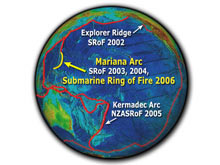
The Submarine Ring of Fire 2006 (SRoF'06) expedition will take place on the Mariana arc. It will be the third Ocean Explorer expedition to the Marianas. This image shows a global view of the Pacific Ring of Fire. The four previous Submarine Ring of Fire expeditions are indicated at Explorer ridge, Kermadec arc, and the Mariana arc. Also indicated are the crest of the mid-ocean ridge system (shown as a dashed line) and the plate boundaries defined by island arcs and trenches (solid lines). Click image for larger view and image credit.
Submarine Ring of Fire 2006
April 18 - May 13, 2006
The Submarine Ring of Fire 2006 expedition is the third in a series of explorations of the submarine volcanoes lying along the Mariana arc, extending from south of the island of Guam northward more than 800 nautical miles (1,450 km). We discovered some amazing places in 2004, including an erupting volcano (NW Rota-1), liquid CO2 venting (NW Eifuku), the shallowest "black smoker" chimneys (East Diamante) yet discovered, and more than 12 new species of chemosynthetic organisms at hydrothermal vent sites. All of us came away from the 2004 expedition with a lingering sense of awe that such amazing places remain undiscovered on Earth, which underscores the value of a national ocean exploration program. We are eager to revisit some of these sites and to make the first dives at several new sites.
Please join us on another voyage of discovery along the Mariana arc!
 Mariana
Arc Virtual
Visits:
Mariana
Arc Virtual
Visits:
Go to the bottom of the ocean with virtual fly-through animations
of 13
possible dive sites. (Flash, 1.1 Mb.)
 NOAA Podcast:
Learn what we hope to discover on this expedition with a video
or audio podcast on the mission. (Quicktime7 H.264, 1.8 Mb.)
Updates & Logs
Click images or links below for detailed mission logs and updates.
 Mission Summary Chief Scientist Bob Embley reflects on the initial findings of the Submarine Ring of Fire 2006 expedition.
 May 12 The Jason II remotely operated vehicle (ROV) takes a "bath" in molten sulfur , and the origins of names like Daikoku, Eifuku, and Nikko are revealed! Includes videos.
 May 11 They may look a little strange, but tonguefish can survive the harsh environment around hydrothermal vents. Includes videos.
 May 10 The
chief pilot of the Jason ROV discusses
the thrill of operating an unmanned submersible in dangerous
waters. Includes QTVR
May 10 The
chief pilot of the Jason ROV discusses
the thrill of operating an unmanned submersible in dangerous
waters. Includes QTVR
 May 9 Becoming a scientist is
like being in love. You fall head over heels at first, but
later on you decide that it's worth all the time and sacrifice. Includes QTVR
May 9 Becoming a scientist is
like being in love. You fall head over heels at first, but
later on you decide that it's worth all the time and sacrifice. Includes QTVR
 May 8 Scientists return to study the NW Eifuku underwater volcano — one of only two places on Earth where liquid carbon dioxide has been observed. Includes videos.
 May 5 Despite vents with low pH (less than 2), high temperatures
(greater than 200°C, or 500°F), and an on-going explosive eruption,
microbes seem to prosper.
May 5 Despite vents with low pH (less than 2), high temperatures
(greater than 200°C, or 500°F), and an on-going explosive eruption,
microbes seem to prosper. May 4 Discovery of the "Sulfur Cauldron" at Daikoku volcano is one of the most exciting accomplishments of the expedition! Includes a podcast and videos.
 May 1 Discover the Five Towers chimney at the Black Forest
vent field,
the multitude of tropical life at the Aquarium site, and the sampling of extinct
chimneys at East Diamante. Includes videos.
May 1 Discover the Five Towers chimney at the Black Forest
vent field,
the multitude of tropical life at the Aquarium site, and the sampling of extinct
chimneys at East Diamante. Includes videos.
 April 30 Who
would want to live on an erupting volcano? Two feisty shrimp species are able to reap the benefits of the volcano's hydrothermal activity.
April 30 Who
would want to live on an erupting volcano? Two feisty shrimp species are able to reap the benefits of the volcano's hydrothermal activity.
 April 29 More than 1,800 ft below the ocean surface, glowing red lava vents from Brimstone
Pit. Read the scientists' report and watch six videos that capture the explosive volcanic
activity. Includes a podcast and videos.
April 29 More than 1,800 ft below the ocean surface, glowing red lava vents from Brimstone
Pit. Read the scientists' report and watch six videos that capture the explosive volcanic
activity. Includes a podcast and videos.
 April 27 A college instructor steps aboard the research vessel (R/V) Melville and
embarks on the experience of a lifetime.
April 27 A college instructor steps aboard the research vessel (R/V) Melville and
embarks on the experience of a lifetime.
 April 25 The Jason II ROV visits the Brimstone Pit as it spews lava and "dancing" bubbles of carbon dioxide. Includes a podcast, videos and
  slideshows.
 April 24 The Ring of Fire team witnesses a "wall" of bubbles around Brimstone Pit and what could be lava extruding on the sea floor. Includes videos.
 April 21 The research team makes its first dive on Seamount X
and discovers sulfurous vents crawling with life. Plus, watch a
Quicktime VR from the deck of the R/V Melville.
April 21 The research team makes its first dive on Seamount X
and discovers sulfurous vents crawling with life. Plus, watch a
Quicktime VR from the deck of the R/V Melville.
The Ring of Fire Missions
Click images or links below for more information on all Ring of Fire missions.
 Magic Mountain Virtual Site
Take a trip to the seafloor! Explore the hydrothermal vents of the Magic Mountain Chimney Fields via a series of interactive computer animations and videos. (Where is Magic Mountain?)
 Submarine Ring of Fire 2007
(July - August) Scientists return to the Kermadec Arc, to explore in great detail the Brothers submarine volcano. This will mark the most comprehensive exploration of this type of arc volcano and is one of the most vigorous geothermaly active yet discovered.
 Submarine Ring of Fire 2006
(April - May) Scientists return to explore active submarine volcanoes lying along the Mariana Arc, extending for more than 800 nautical miles.
 New Zealand American Submarine Ring of Fire 2005
(April - May) Join scientist as they explore the active submarine volcanoes along the Kermadec Arc, located north of New Zealand, with a pair of manned submersibles the PISCES IV and V.
 Submarine Ring of Fire 2004 - Mariana Arc
(March - April) An interdisciplinary team of scientists returned to the submarine volcanoes of the Mariana Arc to explore, utilizing an underwater tethered robot (ROPOS).
 Pacific Ring of Fire 2003
(February - March) An interdisciplinary team of scientists explored the submarine volcanoes of the Mariana Arc lying north of Guam in the western Pacific.
 Submarine Ring of Fire 2002
(June - August) An interdisciplinary exploration team used new technology to investigate the birth of new ocean crust off the coast of western North America, part of the Pacific "Ring of Fire."


