


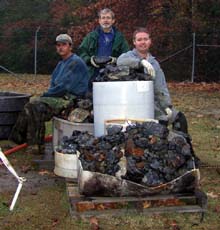
(l to r) Jeff Johnston, Dr. John Broadwater, and Tane Casserley with some of the coal that they have removed during the course of the turret excavation. Click image for larger view and detailed explanation.
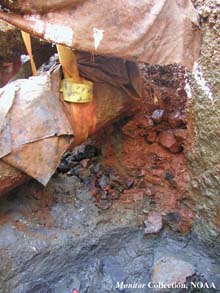
Close-up of some loose and some concreted coal lying on the roof rails under the starboard gun carriage. Click image for larger view and detailed explanation.
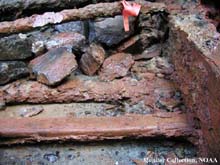
A mound of coal resting up against the turret bulkhead by the muzzle of the port cannon. The coal in this area was piled up from the top of the image down into the turret roof rails.Click image for larger view and detailed explanation.
Earning a Lump of Coal
December 10, 2002
Jeff Johnston
Program Specialist
Monitor National Marine Sanctuary
One of the surprises we encountered during the ongoing turret excavation has been the abundance of coal everywhere inside the turret. We have found large lumps, small lumps, clinker (burned coal), and coal dust in every little nook and cranny, from the rim of the turret all the way down to the roof rails.
When the hull finally came to rest on top of the turret, the aft-most hatch of the port coal bunker ended up over the starboard gun. It is impossible to determine the point at which this hatch gave way, but archaeological evidence indicates that it was not long after the Monitor sank.
We first encountered the turret’s “coal field” during the excavation on site. With the position of the coal bunker over the turret, this did not surprise us. In fact, we expected it. The surprise was the abundance of coal throughout the turret.
The weight of the coal spilling through was probably a factor in the collapse of the turret’s wood deck, but it is still unclear when this occurred.
As the coal spilled into the turret, it began to spread everywhere. We have removed piles of it that were concreted to the bottom and sides of the cannon carriages. These mounds were concreted to the turret bulkhead that rose up from the turret roof all the way to the top of the turret base (it rested upside-down, remember!).
The coal literally fused with the metal components of the turret. The coal dust mixed with silt and sediments in the turret. Over the years, it formed a solid matrix, which slowed the excavation considerably. On many days we felt like precision coal miners in our cave-like environment, hammering and chipping away at lumps that sometimes would only come out in slivers.
But the rewards were great! Sometimes we would free up a mound of coal and find a beautiful piece of engraved flatware or a fragile hard rubber US Navy button buried beneath.
Visitors to the excavation are always impressed with the personal artifacts that we have recovered, but the wayward lumps of coal lying around go mostly unnoticed. It isn’t until they see the bins, buckets, and barrels of coal, all grouped together, that people start to get an idea of the amount of coal we removed. We have certainly speculated about the weight of it all! Does anyone have a really big scale?
Sign up for the Ocean Explorer E-mail Update List.


